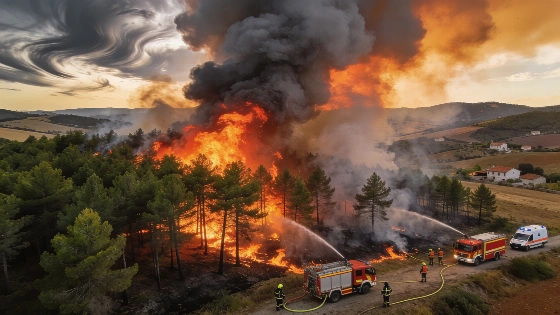
A large wildfire that merged into a single front on Friday is still threatening several towns in Madrid’s southwest, putting emergency crews on alert for a difficult Saturday. Their basic concern is defending San Martín de Valdeiglesias, as authorities warn that changing weather could quickly escalate the crisis. Overnight, firefighters slowed the fire’s advance as humidity rose and temperatures fell, but the situation remains unstable with winds expected to worsen.
Firefighters on the ground say the most severe threat now comes from the Ávila front. It has yet to cross into Madrid, but is advancing rapidly around Cebreros and El Tiemblo. The Madrid front made less progress overnight, with its leading edge now positioned between Robledo de Chavela and Fresnedillas de la Oliva, just past the M-521. Although the fires had not physically joined, emergency teams treated them as a single incident for operational purposes. The Unidad Militar de Emergencias (UME) established a Unified Command to coordinate the response across both regions.
Weather remains the critical factor. Javier Armenteros, Madrid delegate for the Agencia Estatal de Meteorología (Aemet), said temperatures had dropped, with a forecast maximum of 29°C, and humidity had improved compared with previous days. Wind, but, remained a major concern. Gusts were expected to shift northwest and intensify in the afternoon, potentially exceeding 50 km/h. Virginia Barcones, Secretary General for Civil Protection and Emergencies, warned that shifting winds could reach up to 60 km/h and force emergency teams to adapt their strategies. The immediate priority was to protect residents in San Martín de Valdeiglesias and monitor the fire’s movement toward Cadalso and Cenicientos.
The July 2026 event was later identified as the Sierra Oeste fire, formed when three outbreaks in Villa del Prado and San Martín de Valdeiglesias merged. It ultimately burned more than 29,000 hectares and led to the evacuation of approximately a dozen municipalities, making it the largest wildfire in Madrid’s history. Ecologist José Luis Manzano linked the fire’s exceptional spread in part to continuous vegetation after years of reduced grazing and rural land abandonment. The national emergency response also reached Situación Operativa 3 (SO3) during the week of 24-30 July, an unprecedented level information from a report citing Spain’s Ministry for the Ecological Transition and the Demographic Challenge.
The fire’s footprint extended beyond forestland. The Unión de Pequeños Agricultores y Ganaderos de Madrid estimated that 18,500 hectares of affected land could be used for agriculture. The Comunidad de Madrid later distributed nearly 500,000 kilograms of feed to livestock operations and announced 43 urgent reconstruction measures. At the national level, Spain’s firefighting system recorded more than 10,000 flight hours and 50,259 water drops during 2026, figures reported by Europa Press citing the ministry.
The effects also crossed the boundary between Madrid and Ávila. Cebreros reported impacts from both the Burgohondo and San Martín de Valdeiglesias fires, along with water-supply difficulties and damage after subsequent rainfall. Ash and debris also affected water-capture systems in nearby Piedralaves and Casavieja. Pedro José Muñoz, mayor of Cebreros, criticized what he called discriminatory treatment of fire-affected municipalities compared with areas hit by other emergencies.
Muñoz also challenged how the affected area was calculated for state aid. He said the assessment had been reduced from about 50,000 hectares to nearly 38,000 after unburned “green islands” were excluded, and argued that land affected by the San Martín de Valdeiglesias fire should be included because the fires converged within Cebreros. The application period for the relevant aid began on 3 October, more than 70 days after the fire started, leaving municipalities roughly 15 days before the stated deadline. Muñoz described the situation as “a grave discrimination” and the available aid as insufficient. Major fires have struck the Cebreros area in 1986, 2003, 2013, 2021, 2022 and 2026.
Recovery efforts have also focused on preventing further damage from rain and erosion. The Centro para la Defensa contra el Fuego, under the Consejería de Medio Ambiente y Energía de la Junta de Castilla y León, organized an eight-panel exhibition on ecological recovery and urgent interventions. It began in Cebreros and El Tiemblo, with each venue scheduled to host it for two weeks before it moved to other locations in the Valle del Tiétar. The initiative aims to explain restoration measures and encourage participation by affected rural communities.
Recent days have brought similar emergencies to the region, with mass evacuations and rapidly changing fire fronts. For example, thousands were evacuated from Chapinería and nearby towns as wildfires forced authorities to declare a state of emergency. The situation in Madrid’s southwest echoed those challenges, with authorities and residents bracing for a difficult day ahead.
Wildfires are a recurring threat during Spain’s summer months, often fueled by prolonged drought and high temperatures, while unpredictable winds can worsen conditions. Spain has invested heavily in firefighting resources and early warning systems, but extreme weather continues to test those defenses. The focus on San Martín de Valdeiglesias showed the vulnerability of rural communities near forested areas. Later damage to water systems and agricultural land also showed how the consequences can persist after flames are brought under control.