Francesca Thyssen is bringing more than 350 contemporary works to Madrid. Her collection will support the museum's biggest expansion and open a new chapter for the family.
More than 350 contemporary artworks will take the Museo Nacional Thyssen-Bornemisza in a new direction. Francesca Thyssen-Bornemisza is taking the public role once held by Carmen Cervera. Her TBA21 collection will come to the museum through a major donation and a long-term loan, both at no financial cost to the institution.
The planned expansion will give the Madrid museum a new building and a stronger focus on 20th- and 21st-century art. TBA21 describes the deal as the start of a new era for the museum and as a transfer linked to Spain's public collection.
The change is already visible in the family's public appearances. Francesca has presented the project with institutional representatives and has been in closer contact with Borja Thyssen and Blanca Cuesta. She is also giving interviews to El País and El Mundo. Carmen Cervera has reduced her public activity while recovering from pneumonia.
Помимо нового пакета, ранее предоставленный Франческой Тиссен долгосрочный заём оценивался примерно в 70 млн евро. В совокупности с нынешним даром и новым займом масштаб связанных с музеем обязательств приближается к 100 млн евро.
This is not a formal replacement. Cervera remains central to the museum's history after decades as its main public ambassador and a determined defender of keeping the collection in Spain. Francesca has repeatedly recognised that contribution. She has also made clear that the new project belongs to the Museo Nacional Thyssen-Bornemisza, not to her personally.
EFE presents the initiative in the same way. It is an expansion of the institution, not the substitution of one family figure for another.
The numbers show the size of the change. Francesca will donate 186 works valued at nearly 16 million euros. She will place another 179 works, worth about 10 million euros, on long-term loan. The agreement brings TBA21's contemporary holdings into the museum alongside the historic collection inherited from Hans Heinrich Thyssen-Bornemisza.
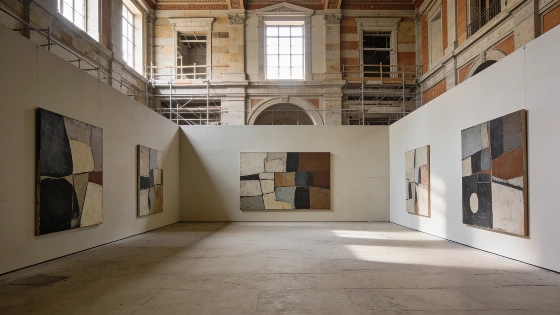
The new site is planned for the Palacio de Hielo y del Automóvil. The publicly owned building is close to the museum's main Madrid site and has been closed since 2007. It has more than 8,000 square metres.
That space is expected to hold the new collection and a wider cultural programme. The project is forecast to become reality in 2032. Reports from La Vanguardia and Telemadrid give different measurements for the future complex. Depending on how the building is counted, estimates run from more than 8,000 square metres of exhibition-related space to about 15,000 to 19,500 square metres.
The Spanish government is transferring the former Palacio de Hielo y del Automóvil to the museum and is taking responsibility for the adaptation and rehabilitation costs. The project was presented by the ministries of Culture and Finance as part of a public cultural policy, not only as a private collection initiative.
The future venue is not meant to be just another gallery. Francesca wants it to host exhibitions, films, lectures and other forms of public participation. Her work through TBA21 has focused on contemporary art, environmental issues, ocean conservation, Indigenous artists and women. She has also described the space as potentially open to younger visitors and able to serve as a climate refuge.
Her return to the museum carries personal weight. She once had mixed feelings about her father's collection moving to Spain. When the paintings left Villa Favorita in Lugano for Madrid, she was 29. She believed the family sacrifice had not been fully acknowledged.
Her view began to change around eight years ago, after Fernando Benzo invited her to take a more active role in the museum's Patronato.
Francesca later found a practical way to work with the museum through TBA21's exhibition programme. In 2019, she reached an agreement with the museum to organise two annual exhibitions using works from her contemporary collection. The deal was first planned to last four years. It continued long enough to prepare the current transfer.
The family relationship has changed as well. Francesca now describes Cervera as generous toward the expansion. She says she respects the work that made the museum possible. She has also developed a closer relationship with Borja Thyssen and Blanca Cuesta. Earlier public disputes have given way to cooperation around the institution and its artistic inheritance.
Carmen Cervera's own collection remains secured in Spain through a 2022 agreement involving a 15-year lease worth 97.5 million euros. Francesca's arrangement follows a different model. The donated works come without financial compensation, while the loan keeps another substantial group tied to the museum for the long term.
Francesca says Spain was ultimately the right destination for her father's collection because Madrid offered exhibition space as well as facilities for restoration and research. TBA21 also settled in Spain two years ago after a decision she describes as personal.
Her children can use the museum to learn about their grandfather. She does not want them to feel forced to inherit its responsibilities.
The choice of language matters. The museum has long been identified with individual members of the family. First it was the baron. Later it was Cervera. Francesca rejects the idea of a personal wing and says the future building should be part of the museum itself.
That does not reduce her influence. It shows that the succession is being presented as a change in the museum's model, not simply as a change in its family representative.
The Thyssen is not abandoning Carmen Cervera's chapter. Her work provides the base for a wider museum shaped by Francesca's contemporary collection. The family's connection with the institution has survived beyond the baron and Cervera.
With the donation and planned expansion, the museum is gaining a route into contemporary art while keeping the continuity that made it possible. Francesca's growing visibility is the public expression of that carefully built transition.