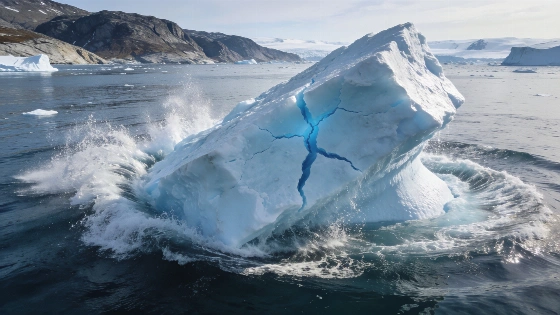
A massive iceberg overturned near Ilulissat, Greenland, as cameras captured the entire event. The dramatic rotation exposed deep blue ice and sent waves across the fjord, highlighting the region’s ongoing ice loss and its global impact.
On July 25, 2026, a camera positioned near the entrance to Greenland’s Ilulissat Icefjord recorded a rare and striking event: a colossal iceberg lost its balance and slowly rolled over in the frigid waters just off the coast. The footage, released by AfarTV, shows the iceberg’s surface fracturing and tilting before the entire block rotates, revealing the deep blue, cracked ice that had been hidden beneath the waterline. No injuries were reported as a result of the incident.
The video sequence captures not only the iceberg’s gradual overturn but also the powerful waves and spray generated by the movement. As the block shifted, smaller fragments broke away, and the main mass rotated until its submerged side emerged, marked by irregular textures and deep fissures. The full recording, lasting nearly an hour, offers a rare real-time look at a process that usually unfolds far from human eyes.
Unpredictable Forces
Icebergs remain afloat due to a delicate balance between their weight and the buoyant force of seawater. When melting, erosion, or internal fractures disrupt this equilibrium, the iceberg’s center of gravity shifts, sometimes triggering a dramatic roll. The newly exposed ice often appears more compact and intensely blue, shaped by years of pressure and the way it absorbs light. Such rotations can unleash strong waves and currents, their intensity depending on the iceberg’s size, shape, and the depth of the surrounding waters.
While these events are visually striking, they are a natural part of the iceberg lifecycle. Uneven melting, collisions with the seabed, and the gradual loss of fragments all contribute to the instability that can lead to a sudden flip. The Ilulissat region, in particular, is known for frequent iceberg activity, making it a focal point for scientific observation.
Ilulissat: A Hotspot for Iceberg Formation
The overturn occurred near the UNESCO-listed Ilulissat Icefjord, a site recognized for its unique glacial dynamics. The fjord is fed by the Sermeq Kujalleq glacier, one of the fastest and most active in the world, with ice moving toward the sea at speeds of up to 40 meters per day. As icebergs break off, many become temporarily stranded in shallow waters near the fjord’s mouth, sometimes remaining for weeks or months before melting enough to continue their journey toward Disko Bay.
For over 250 years, scientists have studied this region to better understand how icebergs form, how glaciers move, and how Greenland’s ice sheet is changing. The area’s activity provides valuable data on the processes that shape the Arctic landscape and influence global sea levels.
Greenland’s Ice Loss in Numbers
According to NASA, Greenland’s ice sheet lost an average of 264 billion metric tons of ice annually between 2002 and 2025. This ongoing loss has contributed to a global sea level rise of about 0.8 millimeters per year during that period, as measured by satellite missions such as GRACE and GRACE Follow-On. Monitoring efforts now include advanced satellite systems and coastal buoys, not only in Greenland but also in countries like Spain, where rising seas pose increasing risks to coastal communities.
Although the dramatic iceberg flip near Ilulissat cannot be directly attributed to climate change based on a single event, it does illustrate the physical processes at work as Greenland’s ice continues to retreat. Long-term data, rather than isolated incidents, are needed to draw firm conclusions about the drivers behind such events.
Elsewhere in the North Atlantic, the movement of large marine species is also being tracked as environmental conditions shift. For example, the recent reappearance of a giant great white shark in Atlantic waters has drawn attention to the changing dynamics of the region’s ecosystems.
As the Ilulissat footage demonstrates, the Arctic remains a place of powerful natural forces and ongoing transformation—where each visible event is part of a much larger story unfolding across the world’s oceans and coasts.