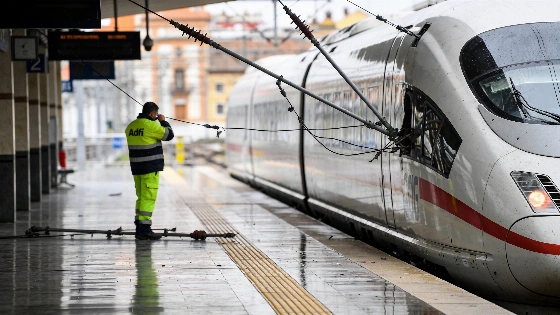
Adif suspended all high-speed trains between Madrid and Barcelona after a lightning strike damaged overhead lines in Catalonia. The closure disrupted Renfe, Iryo, and Ouigo services for at least two hours as authorities prioritized safety and urgent repairs.
Adif suspended all Madrid-Barcelona AVE trains on Wednesday after a lightning strike during severe storms damaged overhead wires near Sant Vicenç dels Horts in Catalonia. The incident occurred between Sant Vicenç dels Horts and El Prat de Llobregat, a basic section of Spain’s busiest high-speed rail line, and prompted emergency repairs, information from Adif and the Ministry of Transport.
By late morning, Renfe, Iryo, and Ouigo trains were already facing delays of up to an hour after being diverted onto a single track. Congestion made the timetable unworkable, frustrating travelers and operators. At 11:00, Adif halted all traffic, saying a full power cut was needed to repair the damaged lines safely. The company said disconnecting the power entirely was the only way to protect workers, as repairs under live wires would have been too dangerous.
The closure was expected to last at least two hours, with service potentially resuming by 13:00 if weather allowed. Adif said on its network status page that crews were working to fix the problem "as quickly as possible." Although the damaged section was relatively short, the disruption affected the entire high-speed network between Madrid and Barcelona, impacting business and leisure travelers. Libertad Digital reported that the Ministry of Transport worked closely with Adif to manage the emergency and keep the public informed.
The disruption came as violent storms swept across Catalonia. The Generalitat restricted movement and suspended classes, university activities, and outdoor sports in five densely populated areas: Baix Llobregat, Vallès Occidental, Garraf, Alt Penedès, and Baix Penedès. The measures affected about two million people. Authorities urged residents to work remotely and take care on the roads. The regional government also sent emergency alerts to mobile phones, advising people to avoid unnecessary travel and stay out of flooded areas, as Catalonia was under the INUNCAT emergency plan for heavy rain.
Barcelona also activated its municipal emergency plan because of the risk of flooding and drainage problems. After storms in recent weeks, the city has faced repeated weather alerts and pressure on its infrastructure. As reported earlier, recent downpours have brought relief from heat while creating new challenges for transport and public services. Vozpópuli also reported disruptions to regional Rodalies services in southern Catalonia, extending the storm’s impact to the region’s rail infrastructure.
Spain’s high-speed rail network is impressive for business and leisure travel, so an extended outage on the Madrid-Barcelona line has immediate economic and logistical effects. Adif’s decision to stop all trains rather than attempt partial repairs or limited service put safety and a quick restoration ahead of short-term convenience. As Catalonia’s weather grows more unpredictable, the reliability of basic infrastructure is under renewed scrutiny. This week’s events show how sudden storms can disrupt even advanced transport networks, and why stopping service entirely may be necessary when safety is at risk.