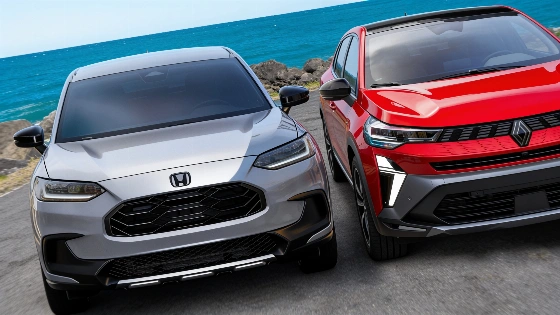
Honda HR-V and Renault Symbioz offer hybrid efficiency and family practicality in a size that sits between urban and compact SUVs. We compare their dimensions, engines, equipment, and value to see which stands out.
Honda HR-V and Renault Symbioz are quietly redefining what it means to buy a family-friendly hybrid SUV in Spain. Both models sidestep the typical B and C segment boundaries, targeting drivers who want the flexibility of a crossover without the bulk of a full-size SUV. Their approach is practical: compact enough for city life, yet spacious enough for family needs, and both carry the coveted Eco label from the DGT.
Size and Space
While the Honda HR-V and Renault Symbioz are close in overall footprint, the Symbioz edges ahead in usable space. The Renault measures 4,413 mm in length, 1,797 mm in width, and 1,575 mm in height, with a wheelbase of 2,638 mm. The Honda HR-V is slightly shorter and narrower at 4,355 mm long and 1,790 mm wide, standing a touch taller at 1,582 mm, and with a 2,610 mm wheelbase.
Where the difference becomes clear is in the boot. The Symbioz offers a generous 460 litres of luggage space, far outpacing the HR-V's 319 litres. With the rear seats folded, the Renault expands to 1,582 litres, while the Honda reaches 1,289 litres. For families or anyone needing to haul more than just groceries, this margin is significant.
Hybrid Powertrains Compared
Both models qualify for the DGT's Eco label, but their paths diverge sharply under the bonnet. The Honda HR-V is available exclusively as a self-charging hybrid, pairing a 1.5-litre four-cylinder petrol engine (107 hp) with an electric motor for a combined 131 hp and 253 Nm of torque. This setup delivers 0–100 km/h in 10.6 seconds and a top speed of 170 km/h. The small 1 kWh battery allows for brief electric-only driving, mainly at low speeds, but helps keep fuel consumption at 5.4 l/100 km and CO2 emissions at 122 g/km.
The Renault Symbioz, meanwhile, offers more choice. The entry-level ECO-G version uses a 1.2-litre petrol engine that can also run on LPG, producing 120 hp and 200 Nm. It accelerates to 100 km/h in 12 seconds and reaches 180 km/h. On petrol, it consumes 5.9 l/100 km (133 g/km CO2); on LPG, 7.1 l/100 km (116 g/km CO2). Above that sits a mild hybrid 140 hp EDC with a 1.3-litre engine and automatic transmission, sprinting to 100 km/h in 9.4 seconds and matching the top speed. Its official consumption is 5.9 l/100 km with 134 g/km CO2. The range-topping full hybrid E-Tech combines a 1.8-litre petrol engine with two electric motors for 160 hp, 0–100 km/h in 9.1 seconds, 180 km/h top speed, and an impressive 4.3 l/100 km fuel use with just 98 g/km CO2.
Equipment and Value
Pricing is a decisive factor. The Renault Symbioz starts at €25,935, making it notably more accessible than the Honda HR-V, which begins at €31,460. This gap is partly explained by equipment and powertrain differences.
The HR-V's base Elegance trim is well-equipped: keyless entry and start, privacy glass, rearview camera with parking guides, 18-inch alloy wheels, front and rear parking sensors, heated front seats, air diffusion system, ECON driving mode, remote connectivity via My Honda+, Honda Magic Seats, Honda SENSING driver assists, adaptive cruise control, a digital i-MID display, 9-inch Honda CONNECT touchscreen with wireless Apple CarPlay and Android Auto, and wireless smartphone charging.
The Symbioz's Evolution trim includes 17-inch wheel covers, emergency braking assist with pedestrian, cyclist, and intersection detection, height-adjustable driver's seat, automatic climate control, front and rear electric windows, hill start assist, LED daytime running lights front and rear, automatic headlights, rain sensor, rear parking assist, a 7-inch digital instrument cluster, and a 10.4-inch OpenR Link multimedia system with smartphone mirroring.
Which Makes More Sense?
Both the Honda HR-V and Renault Symbioz offer a step up from typical B-segment SUVs, but the Renault stands out for its larger boot and broader engine range. While the HR-V's hybrid system is more advanced than the entry-level Symbioz, Renault's mild and full hybrid options close the gap in efficiency and performance. The price difference—nearly €6,000—will be hard to ignore for many buyers, especially given the Symbioz's practicality.
For those interested in how other brands are pushing the boundaries of hybrid and electric vehicles, the recent launch of the BYD Shark plug-in hybrid pickup in Europe highlights the growing competition and innovation in this segment.
As the Spanish market continues to shift toward electrified vehicles, models like the HR-V and Symbioz reflect a broader trend: consumers want efficiency, flexibility, and value without sacrificing everyday usability. The choice between these two will likely come down to priorities—whether it's Honda's technology and equipment, or Renault's space and price advantage.