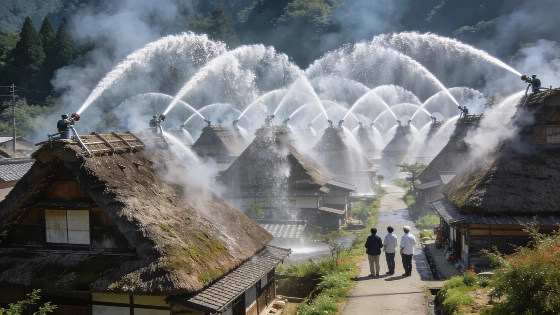
In Kayabuki no Sato, a village in Kyoto Prefecture, residents protect centuries-old thatched houses with a unique network of 62 water cannons. Twice a year, the entire system is tested in a dramatic display that draws visitors and keeps the community prepared for fire risks.
On December 1, 2026, at precisely 11:30 a.m., the village of Kayabuki no Sato in Kyoto Prefecture will activate 62 water cannons in a coordinated test that has become both a vital safety measure and a striking public spectacle. For five minutes, powerful arcs of water will sweep over the thatched rooftops of 39 historic homes, a ritual born from hard lessons learned after a major fire more than two decades ago.
The system, designed to protect the village’s distinctive Kitayama-style houses—some dating back 220 years—was installed after a 2000 blaze destroyed the local Folk Museum. According to official information from Miyama, the cannons are strategically placed throughout the settlement, drawing from a hillside reservoir to ensure every vulnerable roof is within reach. When activated, the rotating jets create a visible curtain of water, enveloping the village in a protective shield.
Fire as the Greatest Threat
Thatched roofs, while beautiful and traditional, are highly flammable. For Kayabuki no Sato, fire remains the single greatest danger. The twice-yearly inspections—held in spring and autumn—are not staged for tourists, but serve as rigorous checks of the system’s readiness. Residents receive hands-on training in fire prevention, and the drills proceed regardless of weather, underscoring the seriousness of the effort. Local authorities and villagers jointly maintain the program, which stands in contrast to reactive firefighting approaches elsewhere, such as Galicia’s deployment of Black Hawk helicopters only after wildfires break out.
From Tragedy to Prevention
The current fire defense network was a direct response to the 2000 museum fire, as noted by Nantan’s public information center. The loss prompted the installation of the 62 water cannons, transforming fire safety from an afterthought into a community-wide priority. Today, the rebuilt museum houses over 200 agricultural tools and artifacts, preserving the area’s rural heritage.
Regular system checks are essential, not only to spot technical issues before an emergency, but also to keep residents alert and trained. In other countries, fire prevention sometimes takes different forms—such as Spanish villages using herds of goats to clear dry vegetation near homes—but Kayabuki no Sato’s approach is uniquely visible and collective.
Preserving Architectural Heritage
The village’s Kitayama-style houses, many built between the Edo and Meiji periods, are recognized for their wooden grid layouts, earthen floors, and south-facing orientation along the Yura River. Of the 50 homes in the core settlement, 39 still retain their original thatched roofs. The northern sector was designated an Important Preservation District for Groups of Traditional Buildings in 1993, with the official heritage listing describing a riverside terrace of stone walls and thatched structures spanning roughly 600 by 300 meters. Local associations oversee both the conservation of the landscape and the daily life of residents. The region is also known for the Daisugi forestry technique, another example of Kyoto’s commitment to traditional craftsmanship.
Visiting the Water Cannon Test
Attendance at the December 1, 2026, test requires advance vehicle reservations, which open on September 1 and close on November 30 or when spaces fill. Fees range from 1,500 yen for cars and large taxis to 10,000 yen for buses, with proceeds supporting landscape preservation. From 11:00 a.m., visitors must leave the village interior and watch from designated paths to avoid disrupting emergency access and daily routines. No temporary parking is provided, and the event goes ahead rain or shine. Reaching Kayabuki no Sato from Kyoto Station by public transport takes about two hours each way.
The village remains a living community, with accommodations, restaurants, shops, and a museum open to guests. Organizers ask visitors to respect private homes and residential areas during their stay.
Kayabuki no Sato’s twice-yearly water cannon display is more than a visual spectacle—it is a reminder of the ongoing effort required to protect cultural heritage from the ever-present risk of fire.