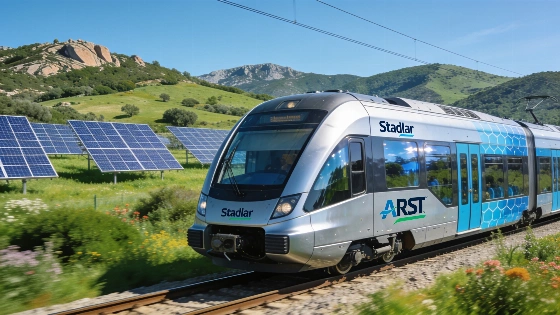
A new hydrogen-powered train, designed by Stadler for ARST, will debut in Sardinia in 2028. Built for narrow-gauge tracks, it promises to cut over 2,100 tons of CO₂ annually and marks a major step in decarbonizing Italy’s regional railways.
Stadler and the Sardinian rail operator ARST have introduced a hydrogen-powered train engineered specifically for Italy’s narrow-gauge railways. The new model, presented in Switzerland, is scheduled to enter service in Sardinia from 2028, offering a significant reduction in emissions compared to the region’s aging diesel fleet.
Italy’s regional railways, especially in Sardinia, Calabria, and Sicily, are defined by 950-millimeter tracks—a legacy of 19th-century engineering that has long complicated modernization. Traditional hydrogen trains, built for standard-gauge lines, were too heavy for these routes. Stadler’s solution is a purpose-built train with a lightweight design and a carefully balanced axle load, making clean propulsion possible without compromising the infrastructure.
Engineering for Narrow-Gauge Challenges
The new train’s architecture centers on a central Power Pack car, which houses the hydrogen fuel cells, storage tanks, and cooling systems. Electricity generated from hydrogen powers and recharges the traction batteries, which in turn drive the train. This configuration allows the train to maintain a low axle load, essential for the narrow and often winding tracks of southern Italy.
Passenger comfort has not been overlooked. The train features air-conditioned interiors, panoramic windows, step-free access for those with reduced mobility, dedicated spaces for bicycles and wheelchairs, WiFi, USB ports, and 220-volt outlets at every seat.
Routes and Rollout
ARST has ordered ten of these hydrogen trains under a framework agreement with Stadler. The first units will operate on routes connecting Alghero Airport to Mamuntanas, Sassari to Alghero, and Sassari to Sorso. Before carrying passengers, each train must pass rigorous safety tests set by Italy’s National Agency for Railway and Road Infrastructure Safety (ANSFISA).
Stadler estimates that replacing diesel units with hydrogen trains will save more than 2,100 tons of CO₂ per year—an amount the company equates to roughly 450 car trips around the globe. Notably, the hydrogen used will be produced entirely with solar energy, ensuring that the entire process, from fuel production to train operation, remains emission-free.
Expanding the Decarbonization Effort
The initiative extends beyond Sardinia. Stadler is also manufacturing nine hydrogen trains for Ferrovie della Calabria and two for Ferrovia Circumetnea in Sicily, all produced at its Bussnang facility in Switzerland. This forms part of a broader Italian strategy to decarbonize regional rail transport, particularly on lines that cannot be electrified.
Italy’s push for cleaner railways mirrors a wider European trend toward sustainable transport. As new technologies reshape the continent’s rail landscape, projects like this echo the ambition seen in Switzerland’s vast underground freight network, which is also redefining how Europe moves goods and people. For a closer look at how Swiss engineering is influencing European rail, see this overview of Switzerland’s underground tunnel system.
With the arrival of Stadler’s hydrogen trains, Italy’s oldest regional lines are poised for a new era—one that balances heritage infrastructure with the demands of a low-carbon future.