Japan is launching a sweeping robotics initiative, aiming for 10 million robots in use by 2040. The plan targets critical sectors like healthcare, elder care and manufacturing, as the country faces a shrinking workforce and rapid population aging.
Japan has set a bold target: by 2040, the country aims to have 10 million robots deployed across care homes, hospitals, factories and other key sectors. This sweeping initiative, announced by the Ministry of Economy, Trade and Industry, is designed to address one of Japan’s most pressing challenges—an acute shortage of workers driven by a rapidly aging population and a declining birth rate.
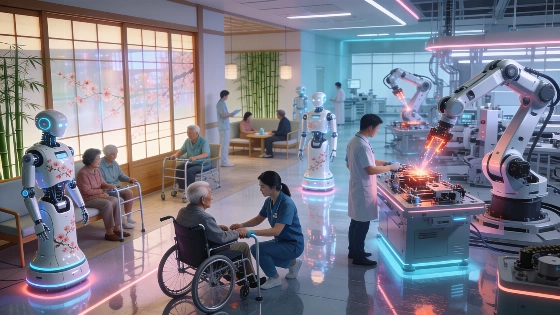
The updated national robotics and physical AI strategy will accelerate the rollout of robots in 18 priority areas, including healthcare, elder care, logistics, food production, and hospitality. The government’s approach is not to replace existing employees en masse, but to fill roles that companies increasingly struggle to staff—especially in physically demanding or less attractive jobs.
Addressing a Demographic Crisis
Japan’s labor market is under mounting pressure. With one of the world’s oldest populations and a shrinking workforce, sectors like elder care and healthcare face severe staff shortages. According to OECD projections, Japan will need an additional 570,000 caregivers by the 2040 fiscal year, just as the number of elderly citizens peaks.
The new robotics plan is a direct response to these demographic realities. Robots will be introduced to support tasks such as physical assistance, logistics, production, and services, with a particular focus on elder care and medical settings. The goal is to ensure essential services remain sustainable as the labor pool contracts.
Noetra: The Technological Core
At the heart of the strategy is Noetra, a national consortium backed by major Japanese companies including SoftBank, NEC, Sony Group, and Honda. Working alongside the National Institute of Advanced Industrial Science and Technology, Noetra is developing a multimodal foundational model for physical AI—enabling robots to interpret and interact with real-world environments using text, images, sound, video, sensors, and physical data.
This next-generation technology aims to move robots beyond simple programmed tasks, allowing them to operate more autonomously and safely in complex settings such as hospitals, care homes, cafeterias, factories, warehouses, and even disaster zones. The government has linked this push to Japan’s existing expertise in fields like geriatrics, disaster response, manufacturing, and the decommissioning of Fukushima Daiichi.
According to Reuters, the project will receive a budget of 387.3 billion yen in 2026, as part of a five-year program to accelerate development and deployment.
Expanding Beyond Factories
Japan is already a global leader in industrial robotics, but the new strategy marks a significant expansion. The updated plan brings sectors like food, beverage, and healthcare into focus, aiming to integrate robotics into daily life rather than confining them to assembly lines.
One of the main challenges will be proving that robots can operate reliably, safely, and cost-effectively outside controlled environments. Hospitals, care homes, and restaurants present unpredictable situations, frequent human interaction, and tasks that demand adaptability and social acceptance.
Despite these hurdles, the Japanese government sees robotics powered by AI as a crucial tool for maintaining essential services and strengthening the country’s technological edge. The race is not just to build more robots, but to create systems that can learn, act, and solve real-world problems.
Context and Outlook
Japan’s robotics initiative comes at a time when many advanced economies are grappling with similar demographic and labor challenges. The country’s experience may offer valuable lessons for others facing workforce shortages and rising care needs. If successful, the strategy could redefine how societies use technology to support aging populations and sustain economic growth.