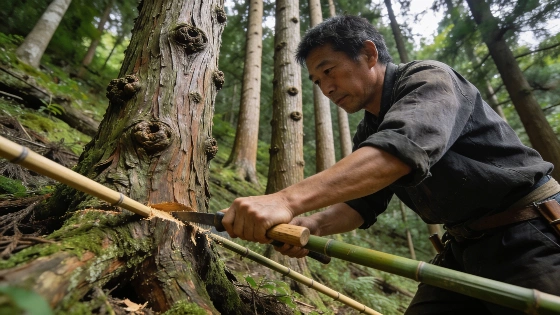
In the forests near Kyoto, a centuries-old method called Daisugi allows wood to be harvested from living cedar trees. This unique approach produces straight, knot-free timber while preserving the original tree for generations. Here’s how tradition and necessity shaped a sustainable forestry practice.
On the steep slopes of Kitayama, just outside Kyoto, Japanese foresters have practiced a remarkable method for harvesting timber for over six centuries. Known as Daisugi, this technique enables the collection of straight, high-quality cedar logs without cutting down the main tree—a solution born from both limited land and growing demand for flawless wood.
Developed during the Muromachi period, Daisugi emerged as a response to the region’s challenging terrain and the architectural needs of the time. The hills of Kitayama offered little space for expanding plantations, yet the popularity of tea houses and traditional sukiya architecture drove up the need for long, uniform beams. According to official records from Kyoto, the cultivation of Kitayama cedar began between 1394 and 1427, closely tied to the rise of the tea ceremony and its distinctive building style.
How Daisugi Works
The process starts with a mature cedar, which is pruned so that only a flat upper platform remains. From this base, skilled workers encourage the growth of multiple vertical shoots, each carefully selected and guided to become a future trunk. Over the years, these shoots are straightened using bamboo poles and ropes, while side branches are removed every two years to ensure the wood remains knot-free and dense. After about two decades, the straight trunks are harvested, but the original tree remains alive, ready to produce new shoots for the next cycle.
This approach is often compared to bonsai for its precision and artistry, but the goal is practical: maximize timber yield from a single tree over centuries. Some ancient Daisugi bases have grown to more than 15 meters in diameter and can support dozens, even over a hundred, vertical trunks at once. The process can be repeated for 200 to 300 years before the tree’s productivity declines.
Environmental and Practical Impact
Daisugi’s main advantage lies in its sustainability. By keeping the mother tree alive, foresters can harvest multiple generations of timber from the same root system, reducing the need for constant replanting and minimizing disruption to the forest ecosystem. The resulting wood, known as taruki, is prized for its strength, density, and flexibility—qualities that made it ideal for traditional Japanese construction, especially in tea houses where aesthetics and durability were paramount.
However, the method is not without its limits. Daisugi requires a specific type of cedar, highly skilled labor, and decades of patient care. The wood, while strong, is not suitable for all modern structural needs, particularly where heavy loads are involved. As noted in the official Kyoto documentation, the technique is deeply rooted in local tradition and geography, making it difficult to replicate elsewhere.
Legacy and Relevance Today
While Daisugi was never intended as a modern environmental policy, its principles resonate with today’s interest in sustainable forestry and land restoration. The method demonstrates how necessity and ingenuity can shape practices that balance resource use with long-term conservation. As reported by Talent24h, the continued survival of Daisugi depends not only on the trees themselves but also on the preservation of the specialized knowledge required to maintain them.
For those interested in forestry, architecture, or cultural heritage, Daisugi stands as a living example of how traditional techniques can offer solutions to contemporary challenges—provided the skills and patience to sustain them are not lost.