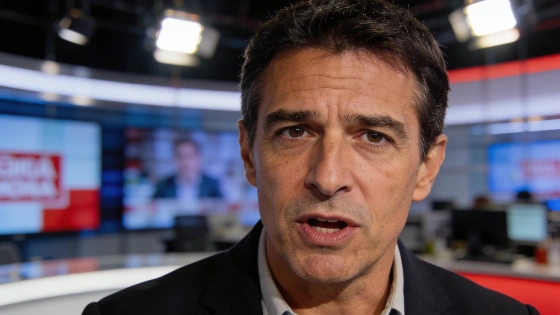
Jesús Cintora broke from script to attack conspiracy theories aired after Maricarmen’s death, calling out both the originators and those who let the claims spread on national television.
Midway through his broadcast, Jesús Cintora cut in sharply. He called out what he described as “barbarities” swirling around Maricarmen’s death. The woman’s eviction had already turned her into a face of Spain’s housing crisis, but now her story was being twisted on air. Cintora, hosting ‘Mañaneros 360’ on La 1, took direct aim at the claim that Maricarmen’s ordeal was staged. That theory, floated by journalist Chapu Apaolaza on ‘Horizonte’, went unchallenged by hosts Iker Jiménez and Carmen Porter.
The core accusation: Maricarmen’s eviction and activism were supposedly part of a planned operation, allegedly organized in La Mareta. Apaolaza claimed there was a “casting” to pick a woman for a stretcher scene and dismissed the Sindicato de Inquilinas as a “fake” union. Cintora didn’t let it slide. He pressed on how such talk could air without pushback, especially given the Sindicato’s long fight for tenant rights. Independent Spanish media confirm Maricarmen Abascal, 87, died October 7, 2026, at Madrid’s Gregorio Marañón hospital after being hospitalized post-eviction on September 23. She had spent nearly seven decades in her apartment. RTVE and other outlets report she lived with 50% disability and mobility problems.
On September 28, the Sindicato de Inquilinas announced an agreement with the property company Urbagestión that would have allowed Maricarmen to return home, but the deal came too late.
Cintora didn’t just single out Apaolaza. He accused Jiménez and Porter of “abject consent” for letting the conspiracy claims go unchecked. “Dan asco,” he said on air. His pushback defended Maricarmen’s legacy and called out the broader pattern of media figures amplifying or tolerating baseless stories at the expense of real social battles. The Sindicato de Inquilinas publicly tied Maricarmen’s death to the “torturous process” after her eviction. Still, independent publications confirm there’s no medical or official probe linking her death directly to the eviction.
The fallout has spilled into other TV programs, showing just how charged the housing debate has become. Conspiracy rhetoric aimed at undermining grassroots activism isn’t new, but Cintora’s move signals a refusal to let these narratives pass unchallenged on mainstream TV. The scrutiny echoes what other public figures have faced in recent Spanish controversies, including the Real Madrid political symbolism dispute in Ceuta.
When TV turns into a platform for unfounded accusations, the impact hits more than just the people named. Cintora’s on-air stand highlights that responsibility for what gets broadcast doesn’t stop with the person making the claim. It lands on those who give them airtime and those who stay silent. In a media climate where spectacle often drowns out substance, his intervention cut through the noise.
Following Maricarmen’s death, the Sindicato de Inquilinas announced a general housing strike for November 11, and the case sparked mass protests, making the housing issue a central political topic in Spain.