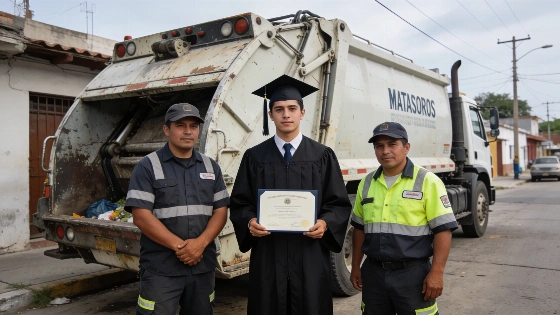
Photos of José Israel Hernández Chávez celebrating his law graduation in full academic regalia beside a municipal garbage truck have resurfaced in 2026. His story highlights the realities of working students in Mexico and the determination required to overcome economic barriers.
When photos of a young man in a graduation gown standing next to a municipal garbage truck began circulating again in August 2026, they brought renewed attention to the realities of social mobility in Mexico. The man in the images, José Israel Hernández Chávez, first drew notice two years earlier for earning his law degree while working as a waste collector in Matamoros, Tamaulipas.
Hernández Chávez was 21 when he graduated from the Universidad de Matamoros on February 9, 2024. Instead of celebrating in a typical venue, he returned to the Public Cleaning Department, wearing his gown and cap for photos with the truck that had been part of his daily life. This was not a publicity move, but a way to honor the job that paid for his education and the coworkers who supported him through years of fatigue and doubt.
By the time he graduated, Hernández Chávez had worked in municipal waste collection for about five years, with roughly four of those years spent juggling both work and university.
His routine was demanding. Each weekday started before dawn, with classes from 7:00 to noon, then an eight-hour shift collecting waste from 14:00 to 22:00. Some later reports exaggerated his hours, but local coverage at the time confirmed this tough but realistic schedule. The work was necessary—without it, he could not have paid tuition or covered basic expenses.
Financial pressure nearly forced him to quit more than once. He later credited his parents and coworkers for encouraging him to keep going, even as his social life disappeared and free time became rare. "You don't rest, you have no time for fun," he said, describing years spent moving between classrooms and the streets of Matamoros, rarely seeing daylight outside of work or study.
After the graduation ceremony, Hernández Chávez returned to the cleaning department to share his achievement with those who had seen his struggle up close. His coworkers said they were proud to see someone from their ranks finish a university degree, something uncommon in a field often overlooked or stigmatized. The photos—first shared on Facebook, then picked up by Mexican and Latin American media—captured not just a personal milestone but a statement: working as a "fajinero" was, in his words, "an honest job." He refused to hide or minimize the work that made his studies possible.
According to recent reports, there is no official confirmation that Hernández Chávez has moved into a legal career, and as of August 2026, his current job status is unverified. Media outlets such as Talent24h and Jurnalul note that while he finished his law degree, he did not immediately leave his municipal cleaning job after graduation.
Despite earning his law degree, Hernández Chávez did not leave his municipal job right away. In early 2024, he said he hoped to find legal work but would keep collecting waste until he found the right opportunity. Later reports mentioned the possibility of a position in the municipality's legal department, but there is no public confirmation that he made that transition. As of August 2026, his current employment is unconfirmed, and his age at graduation—21—should not be confused with his age now.
What is clear is that Hernández Chávez finished his law studies while working full-time in public sanitation, celebrated with the people who mattered most, and spoke openly about the dignity of his work. The renewed attention to his graduation photos does not mark a new milestone or career change, but it does highlight the obstacles many students face in Mexico's higher education system.
Stories like this show the gap between official narratives of opportunity and the reality for working-class students. Hernández Chávez's path is not a fairy tale of sudden change, but a record of steady effort, family support, and pride in every part of his journey. The fact that his story still resonates years later says less about viral inspiration and more about the ongoing barriers to social mobility in Mexico. For all the celebration, the question remains why stories like his are still so rare.
For further details, see the original report on Talent24h.