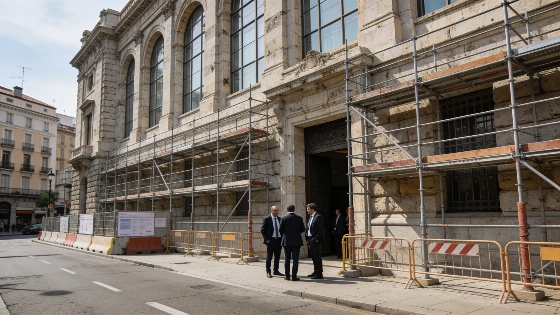
Spain’s government and Francesca Thyssen-Bornemisza have agreed to a major expansion of the Museo Nacional Thyssen-Bornemisza. The project includes a €90 million renovation of the Palacio de Hielo to house contemporary art, but key heritage spaces remain at risk.
The Museo Nacional Thyssen-Bornemisza is set for its largest expansion yet, following an unexpected agreement between Francesca Thyssen-Bornemisza and the Spanish government. Central to the plan is the transformation of the long-vacant Palacio de Hielo, a landmark behind the Hotel Palace, into a new space for contemporary art and museum operations.
The deal, announced on September 16, 2026 by Culture Minister Ernest Urtasun and Finance Minister Arcadi España, brings 365 works from the TBA21 Foundation into Spain’s national collection. The arrangement includes a donation of 186 pieces valued at €15 million and a long-term loan of 179 more, worth €10 million. With earlier commitments, the total value of art entrusted to the state nears €100 million. In return, the government will fund the renovation of the Palacio de Hielo y del Automóvil, with initial costs projected at €90 million. Some sources suggest the budget could be closer to €70 million, reflecting ongoing uncertainty.
The Palacio de Hielo y del Automóvil has stood empty since 2007, after decades of use by state institutions.
The Palacio de Hielo opened in 1922 and was one of Spain’s first major buildings to use reinforced concrete for large, open interiors. Its original ice rink hosted the country’s first league hockey match and early car exhibitions. Over time, the building shifted from a leisure venue to state use, housing the Centro de Estudios Históricos and later the CSIC. Inside is a library designed by Miguel Fisac in 1950, a rare example of Spanish interior design that survived a major fire in 1978.
The future of Fisac’s library is now uncertain. Since the CSIC left in 2007, the Palacio de Hielo has remained empty. A 2011 city plan reduced its heritage protections, requiring only the preservation of the exterior façade. The library, sealed since 2019, could face demolition or major changes depending on the outcome of an international architecture competition planned for 2027. Heritage advocates are concerned, especially after the demolition of Fisac’s La Pagoda in 1999. Recent urban planning decisions have weakened the building’s protected status, leaving the library particularly vulnerable.
Meanwhile, the Thyssen family has reached a rare agreement. Francesca Thyssen and Carmen Cervera, previously divided over the family legacy, now present a united front with Borja Thyssen. This partnership allows the museum to combine its classical collection with the experimental works of TBA21, including pieces by Ai Weiwei, Olafur Eliasson, and Marina Abramović. The expansion will also ease crowding at the Palacio de Villahermosa and bring conservation, research, and education under one roof.
The project timeline remains preliminary: the program and architecture competition are expected to be defined in 2026, with design development in 2027–2028 and construction starting from 2029. The final budget and scope are still subject to change, as official figures vary between €70 and €90 million in different reports.
The project aims for construction to begin in 2029 and for the new museum to open in 2032, but restoring a century-old building and adapting it for new uses leaves many details unresolved. The inclusion of the Centro Memorial de las Víctimas del Terrorismo in the same building adds further complexity. According to Spanish news agencies, the government’s official position is that the building will serve both as a museum and a public cultural space.
As Madrid’s city center faces ongoing issues—noise, congestion, and heritage preservation among them—the Thyssen expansion will test whether the city can balance new ambitions with respect for its architectural past. The government’s decision to invest public funds at this scale is a bet on culture as a force for Madrid’s future. But with the fate of Fisac’s library still undecided and the project’s logistics far from settled, the outcome remains uncertain. Madrid’s museums now stand at a crossroads: the city could gain a major new cultural landmark, or face another round of debate over how to balance progress and preservation.