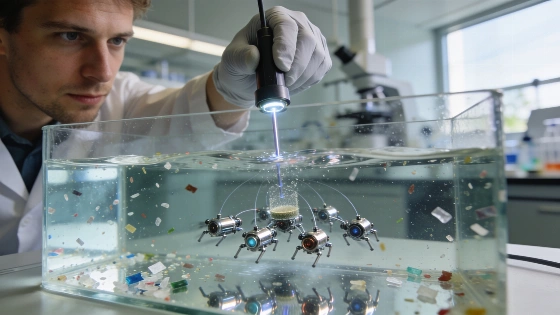
A team in Ostrava has developed magnetic microrobots that capture microplastics from water and soil with unprecedented efficiency. Early lab tests show up to 94% removal in water and 81% in moist soil, but real-world challenges remain.
In a controlled laboratory breakthrough, scientists at the VSB Technical University of Ostrava have demonstrated that swarms of magnetic microrobots can extract up to 94% of polystyrene microplastics from water and 81% from moist soil within just one hour. The results, published in NPG Asia Materials on August 1, 2026, mark a significant step in the fight against microplastic pollution, though the technology is still far from real-world deployment.
The system relies on tiny structures made from layered MXene Ti3C2Tx microparticles and nickel nanoparticles, each about 500 nanometres in size. These microrobots are propelled and steered by rotating magnetic fields, eliminating the need for onboard motors, batteries, or electronics. Instead, external magnetic fields synchronize their movement, allowing precise navigation through water or soil samples. In tests, the robots reached speeds of 22.1 micrometres per second under a 5-millitesla, 3-hertz field.
How the Robots Work
The MXene surfaces act as powerful adsorbents, binding microplastic particles on contact. The robots' mobility enables them to actively seek out and capture dispersed contaminants, rather than passively waiting for pollutants to pass through a filter. Once microplastics are collected, the robots can be retrieved magnetically, concentrating the captured material for removal.
In soil, the microrobots navigated water-filled microenvironments, helping to dislodge and recover trapped plastic fragments. The approach builds on previous research into magnetic materials for water purification, but extends the concept to soil remediation—a domain where traditional filtration is ineffective.
Lab Results and Limitations
Researchers tested the robots on 1-micrometre polystyrene (PS) particles and polyethylene terephthalate (PET) fragments up to 150 micrometres. After 60 minutes, active microrobots removed 94.0% of PS and 89.2% of PET from water, compared to 81.1% and 74.4% for static material. In moist soil, the removal rates were 80.6% for PS and 72.2% for PET, versus 70.7% and 52.5% without movement. The largest improvement—nearly 20 percentage points—was seen with PET in soil.
However, these figures come from controlled lab conditions using prepared suspensions and Petri dish soil samples. The system has not yet been tested in natural water bodies, open soils, or environments with complex mixtures of contaminants. Rivers and real soils introduce variables like organic matter, minerals, roots, and fluctuating moisture, all of which could impact performance. The energy and material requirements for large-scale application also remain unknown.
Safety and Environmental Concerns
One unresolved issue is the use of nickel, which provides the robots' magnetic response but could release metal ions if not fully recovered. The authors caution that incomplete retrieval may lead to secondary contamination. Before any open-environment use, safer magnetic materials, thorough toxicological studies, and robust recovery protocols will be essential. For now, the most plausible applications are in closed systems such as industrial effluents or treatment plants, where containment is easier to guarantee.
Policy Context and Next Steps
This research arrives as the European Union intensifies efforts to curb microplastic emissions. The Zero Pollution Action Plan targets a 30% reduction by 2030, and new REACH restrictions on intentionally added synthetic particles took effect in October 2023. The 2025/2365 regulation, effective from December 2025, imposes stricter controls on plastic pellet losses, especially for facilities handling over five tonnes annually.
While the Ostrava team's technology is not yet ready for environmental deployment, it offers a glimpse of future tools for tackling localized microplastic contamination. Demonstrating effectiveness, safety, and economic viability outside the lab will be the next major challenge.
For those interested, the full study is available in NPG Asia Materials.