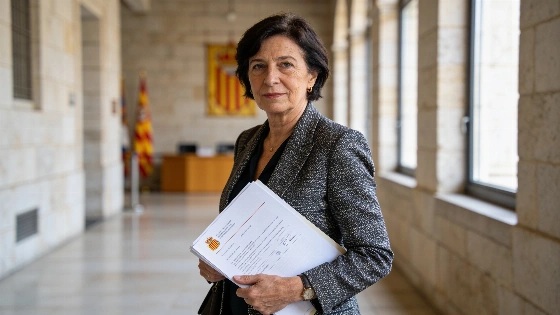
Meritxell Batet, former Congress president, takes charge of Fundación Avanza. The PSOE think tank had lacked a leader since March. César Luena steps in as vice president, marking a new phase for the institution.
Meritxell Batet, a prominent figure in the PSC and former president of the Congress, has been named the new head of Fundación Avanza, the PSOE’s main think tank. The appointment, confirmed by the foundation’s board this Friday, ends a months-long vacancy following the death of Manuel Escudero in March. According to sources from the PSOE cited by EL PAÍS, Batet will now steer the institution at a time when the party is seeking to reinforce its ideological stance.
Alongside Batet, César Luena, a 45-year-old MEP from La Rioja and the first secretary of Organization under Pedro Sánchez, has been selected as vice president. Luena previously served on the scientific council of Fundación Avanza and currently sits on the European Parliament’s Committee on Environment, Climate and Food Safety, while also teaching at Universidad Carlos III de Madrid. His new role signals a strategic move by the PSOE to strengthen its intellectual base, especially as Fundación Avanza was established in 2024 to counterbalance the influence of Fundación FAES, which is linked to the PP.
The leadership changes do not require approval from the PSOE’s federal committee, which is set to meet this Saturday. Batet’s appointment comes after her decision in September 2023 to step back from frontline politics, following 19 years of service that included a term as Minister of Territorial Policy and Civil Service in Sánchez’s first government. She led the PSC’s list in the July 23 general elections, after which she cited satisfaction with her political career and the party’s electoral performance in Catalonia as reasons for her departure.
During her tenure as Congress president, Batet faced significant challenges, including managing the legislative response to the COVID-19 pandemic. The Constitutional Court later ruled that restrictions on parliamentary activity during the initial lockdown had infringed on deputies’ rights, a decision prompted by a Vox petition. Batet also had to navigate frequent incidents of political polarization, which have continued to shape the tone of parliamentary sessions. These pressures contributed to her decision not to seek another term as president of the chamber.
Manuel Escudero, who passed away at 79, played a key role in the PSOE’s internal dynamics, notably coordinating Pedro Sánchez’s successful 2017 leadership campaign alongside José Félix Tezanos, now head of the CIS. After Sánchez’s return to power in 2018, Escudero was appointed ambassador to the OECD in Paris and later returned to help launch Fundación Avanza. Batet now takes over this legacy, with the think tank positioned as a central platform for the PSOE’s ideological renewal in response to the rise of far-right populism, which Escudero once described as “la cruzada ultra.”
The PSOE’s move to reinforce its think tank leadership comes amid broader political maneuvering across Spain’s parties. For example, recent developments in Andalusia have highlighted the complexities of coalition-building, as seen when Juan Manuel Moreno and Vox engaged in tense negotiations over government formation, a situation detailed in coverage of the Andalusian investiture talks. Such dynamics underscore the importance of strong party structures and strategic planning in Spain’s evolving political landscape.
Fundación Avanza’s renewed leadership is expected to play a significant role in shaping the PSOE’s policy direction and public messaging. The think tank’s creation was a direct response to the growing influence of right-wing organizations and the need for a robust ideological framework. As Spain continues to experience political polarization and shifting alliances, the effectiveness of institutions like Fundación Avanza may prove crucial for the country’s major parties.