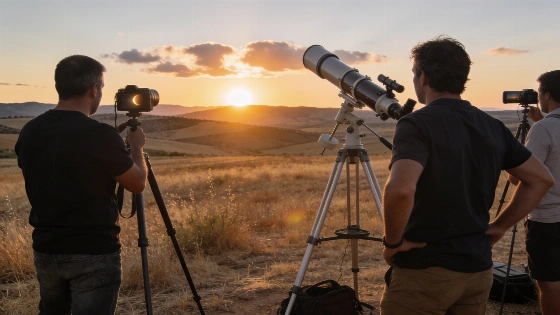
Meteorologists urge eclipse watchers to monitor cloud cover west of their location. Local forecasts may mislead, risking missed views. Storms and high temperatures add to the challenge in several regions.
With the solar eclipse just a day away, Spanish meteorologists are urging the public to rethink how they check the weather before choosing a viewing spot. The key risk, experts say, is not the clouds directly overhead, but those lying dozens of kilometers to the west. This detail, often overlooked, could determine whether the eclipse is visible or lost behind a bank of clouds.
Benito Fuentes from the Agencia Estatal de Meteorología (Aemet) explains that during the eclipse, the sun will be low on the horizon—about five degrees above it. As a result, clouds to the west, not those above, are most likely to block the view. Fuentes advises checking forecasts for areas west of your planned location, since these clouds will be in the line of sight between you and the sun. The Aemet’s special eclipse bulletin, updated daily since last Friday, highlights that interfering cloud cover is expected mainly to the west and slightly north of observation zones, sometimes many kilometers away.
The distance at which clouds become a problem depends on their type. Low clouds, marked green in the Instituto Geográfico Nacional’s eclipse viewer, can obstruct the sun from 10–15 kilometers to the west. Medium clouds (blue) may cause issues from 20–60 kilometers away. High clouds (pink) are less of a concern, as they tend to let sunlight through. The main threat comes from medium and low clouds, which are thick enough to hide the sun completely.
Fuentes recommends comparing satellite images with the sky at your location to judge whether clouds will interfere. The overall weather outlook remains stable, with intense heat, high or extreme wildfire risk, and only localized cloud cover expected. Rubén Del Campo, Aemet spokesperson, confirms that the forecast for the day of the eclipse has changed little since the first special bulletin, except for a higher risk of storms in the southeast.
Storms could develop in the Penibético system, affecting areas like Albacete, Murcia, Granada, and Almería, where yellow alerts are in place. Isolated, weaker storms may also appear in parts of Teruel and northern Castellón. Most of Spain is expected to have clear skies, especially along the path of totality, but the Cantabrian coast remains the least favorable. Northern winds are bringing humidity and dense low clouds to Cantabria, Asturias, and the north coast of Galicia, making eclipse viewing difficult in these areas. Mountain regions in Asturias may see clearer conditions, while central and coastal zones are likely to remain cloudy. The Canary Islands will also experience intervals of low clouds on the northern slopes of the larger islands.
Uncertainty remains for the Alborán area, including the Andalusian Mediterranean coast, where low clouds and fog could hinder visibility. Additionally, convective clouds may form after midday in the Penibético and Ibérico systems, as well as in parts of the Catalan and eastern Aragonese Pyrenees. These clouds typically develop through the afternoon and may dissipate as evening approaches, but their exact impact is hard to predict.
Temperatures are forecast to be very high, exceeding 35°C across most of the peninsula, except for the Cantabrian region (25–30°C) and some Mediterranean coastal areas (up to 30°C, but with higher perceived heat due to humidity). In the Ebro, Guadalquivir, Tajo, and Guadiana valleys, temperatures could surpass 40°C. By the time of totality, around 8:30 p.m., temperatures may drop by 2–5 degrees, but prolonged exposure to the heat remains a concern for those waiting outdoors.
The risk of wildfires is another major issue, with very high or extreme danger across much of mainland Spain and the Balearic Islands. Only parts of northern Galicia, the Cantabrian area, eastern Pyrenees, mid-Ebro, and southeastern Andalusia are expected to see moderate or high risk. Authorities urge maximum caution to prevent any ignition of fires during this period of elevated danger.
For those planning to observe the eclipse, it is crucial to monitor not just local forecasts but also satellite imagery and regional updates. As highlighted in recent coverage of cloud risks for eclipse viewing in Spain, even small changes in cloud movement can make the difference between a clear view and disappointment. The combination of meteorological factors this year means preparation and flexibility are essential for anyone hoping to witness the event.
Solar eclipses are rare and draw significant public interest in Spain. The last total eclipse visible from the country occurred in 2005, and the next will not happen until 2039. The Aemet and other agencies provide real-time updates and satellite imagery to help the public make informed decisions. Observers are also reminded to use proper eye protection, as looking directly at the sun without certified eclipse glasses can cause permanent eye damage. Local authorities in affected regions have issued additional guidance on safety and fire prevention during the event.