Javier Milei visited Madrid without meeting Spanish leaders, using the stage to back Israel and criticize left-wing policies. Vox and PP figures attended, highlighting ongoing political tensions.
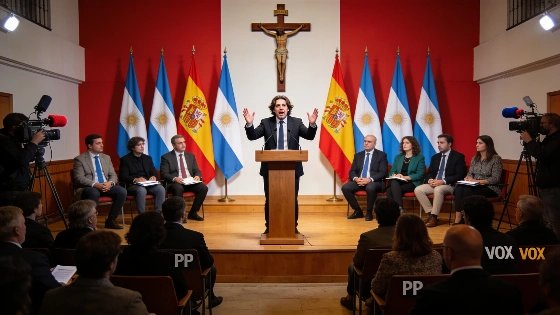
Argentine President Javier Milei made his sixth trip to Madrid since taking office, once again avoiding meetings with Spain’s government or King. Instead, Milei used his appearance at the CEU San Pablo University’s summer courses to deliver a forceful defense of Israel, describing the country as a “bastion of the West” amid growing international isolation over its actions in Gaza and conflicts with Lebanon and Iran.
Speaking before an audience of 300, largely from Christian backgrounds, Milei argued that left-wing groups and terrorists oppose Israel because of its Western values. While this statement was met with silence, other parts of his speech—such as his criticism of socialism and his claim that Karl Marx’s writings were “satanic”—drew applause. Milei presented himself as a proponent of a capitalist interpretation of Judaism, distancing his views from traditional Catholic social doctrine.
Referencing the Torah, Milei asserted that free-market capitalism aligns with Judeo-Christian values and is embedded in the “tablets of the law.” He dismissed the concept of social justice as mere envy and rhetoric, insisting that charity should be voluntary, not enforced by the state. According to Milei, state-imposed redistribution through taxation amounts to theft disguised as altruism.
The Argentine leader previewed his upcoming book, ‘La moral como política de Estado’, arguing that capitalism is not only economically efficient but also morally superior. He rejected the idea of market failures as an “aberration” and elevated life, liberty, and private property as the highest moral values. Milei’s speech blended ultraliberal economic proposals with ultraconservative principles, warning that laws permitting abortion or euthanasia are illegitimate if they conflict with natural law, regardless of their legal status.
Unlike his previous visit, when he triggered a diplomatic crisis by calling the Spanish Prime Minister’s wife “corrupt,” Milei avoided direct confrontation with Pedro Sánchez. However, he alluded to political scandals, referencing hypothetical cases of missing millions or jewelry, and made veiled remarks about politicians’ spouses. He also addressed criticism of his approach to anarcho-capitalism, noting that leaders face many constraints, but highlighted his record of repealing 16,000 regulations in two years—an average of 17 per day. Milei argued that excessive regulation is stifling growth in European countries.
The event drew several Vox deputies, including José María Figaredo, Carlos Hernández Quero, and José María Sánchez, though party leader Santiago Abascal was absent after meeting Milei earlier in the week. Vox has adopted deregulation policies inspired by Milei and established a deregulation vice presidency in coalition governments with the PP. The PP was represented by Madrid’s mayor, José Luis Martínez Almeida, and economic vice secretary Juan Bravo, among others. According to PP sources, Milei had no scheduled meeting with party leader Alberto Núñez Feijóo due to agenda conflicts.
As is customary during his international trips, Milei received an honor—this time, the medal of honor from CEU San Pablo University. The presence of Vox and PP figures at the event underlines the ongoing political realignment on the Spanish right, a dynamic also seen in recent regional negotiations, such as those described in coverage of Vox’s role in Andalusia’s government talks.
For context, Spain and Argentina have experienced diplomatic strains in recent years, often linked to Milei’s outspoken style and controversial statements. The CEU San Pablo University, affiliated with the Asociación Católica de Propagandistas, is known for hosting conservative figures. Milei’s repeated visits to Spain, coupled with his refusal to engage with official state representatives, continue to draw attention to shifting alliances and ideological divides within Spanish politics.