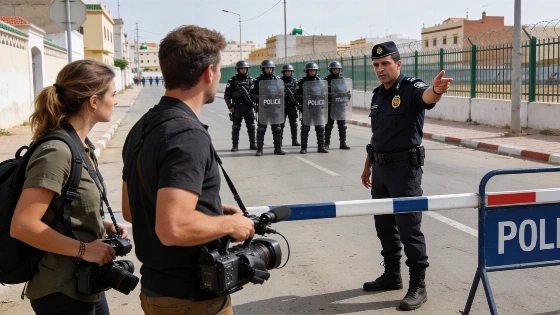
Moroccan officials forced Efe and TVE journalists to leave Castillejos. The reporters were covering police action against migrants near the Ceuta border. The order came without explanation and under threat of equipment confiscation.
Moroccan authorities have demanded that journalists from Efe and TVE immediately leave the city of Fnideq (Castillejos), where they were reporting on a police operation at the border with Ceuta. The order was delivered on Saturday by Youssef Hajji, the top local representative of the Ministry of the Interior, as the reporters covered a forceful intervention by Moroccan riot police to disperse hundreds of migrants attempting to approach the Spanish enclave. The migrants, mostly from sub-Saharan Africa, were met with tear gas and batons as they tried to reach the border area.
During the incident, Hajji approached the Efe correspondent and instructed them to exit the city without delay, offering no justification for the decision. The same directive was then issued to the TVE crew, with a warning that their press credentials and equipment could be confiscated if they failed to comply. The journalists had been documenting the tense situation as Moroccan security forces moved to prevent large groups of migrants from reaching the border fence.
Efe has since attempted to contact the Moroccan Ministry of the Interior for clarification, but has not received a response. The director of Communication at the Ministry of Youth, Culture and Communication stated that efforts are underway to clarify the circumstances surrounding the expulsion. The lack of official explanation has raised questions about press freedom and transparency in the handling of sensitive border events.
This development comes amid ongoing friction between Spain and Morocco over migration and border management. In recent years, the Ceuta and Melilla frontiers have become flashpoints for diplomatic tension, with both countries facing pressure to control irregular crossings. The situation in Castillejos echoes previous disputes, such as when Rabat threatened to suspend extradition agreements, a move that drew sharp criticism from Spanish political parties. For further context on the broader diplomatic backdrop, see the analysis of recent tensions between Madrid and Rabat in this related report.
Ceuta, along with Melilla, represents one of the European Union's only land borders with Africa, making it a frequent destination for migrants seeking entry into Europe. The Spanish government has repeatedly called for greater cooperation with Moroccan authorities to manage migration flows and ensure the safety of both border personnel and those attempting to cross. The expulsion of Spanish journalists from Castillejos highlights the ongoing challenges in reporting on these sensitive issues and underscores the complex relationship between media access, security operations, and international diplomacy at Spain's southern frontier.