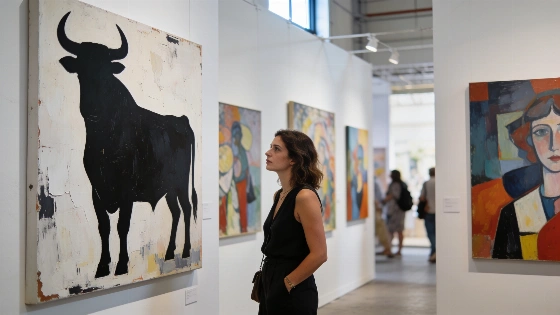
Osborne and Lucha de Gigantes will present 16 works by nine artists at Estampa from 24 to 27 September 2026. The exhibition draws on roads, family memories and Spanish popular culture as the Toro de Osborne reaches its 70th anniversary.
The Toro de Osborne reaches its 70th anniversary through an exhibition built around memory rather than advertising. Osborne and Lucha de Gigantes will present 16 works by nine creators at Estampa from 24 to 27 September 2026. The works draw on a familiar Spain of roads, landscapes, family life, traditions and childhood memories.
The project places the company's best-known symbol in a new visual setting. Each artist takes a different approach, but the collection keeps shared cultural references and personal feeling at its centre.
Around 90 Toro de Osborne silhouettes or roadside billboards are still preserved across Spain, according to Spanish press coverage.
The exhibition does not present the brand as a fixed image. Instead, it uses the roads people travel, the places they remember and the family scenes they carry with them as material for contemporary art.
The collaboration will be shown at Estampa, the contemporary art fair. It comes during a wider run of cultural activity covered in an earlier cultural report. It also gives Osborne a place in an art setting rather than a standard promotional space.
Rocío Osborne, the company's communications director, says the anniversary is a chance to look at how familiar brands change and keep producing new stories and forms of artistic expression. As 20minutos reports, she sees the exhibition as part of a longer discussion about how well-known symbols can take on new meanings without losing their public identity.
The Toro de Osborne has long moved beyond its original advertising function and become part of Spain’s visual identity. That history helps explain why the anniversary project focuses on collective memory and cultural association rather than direct product promotion.
Gabriel Suárez, the creator and driving force behind Lucha de Gigantes, describes the project as a personal connection to the values associated with Osborne. He links childhood nostalgia, road trips and family memories to a shared memory shaped by the effort and optimism of a generation.
The exhibition wants to bring art closer to its audience.
Its organisers want visitors to meet the works without needing an explanation first. People can look, feel and respond to what each piece communicates. They do not have to follow one interpretation set in advance.
That approach explains the use of everyday references. Roads and landscapes provide the setting. Family life, traditions and childhood memories give the works their emotional language. The artists then turn those elements into contemporary forms that can connect experiences across generations.
For Osborne, the event is also a stated investment in culture and in new ways of reaching audiences through relevant experiences. The Toro de Osborne's 70th anniversary gives that strategy a clear occasion. The 16 works are its main expression.
The result goes beyond a simple tribute to an emblem. Nine creators place a familiar Spanish image inside their own memories and ask what remains alive in it. The exhibition's strongest idea is that Osborne is more than a roadside symbol. It can also be a starting point for new stories that the public is free to interpret.