Pedro Sánchez is calling for binding digital rules to protect children. Spain is backing a minimum social media age of 16 and a digital age-verification system.
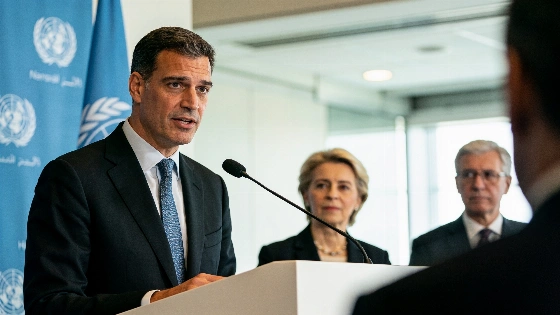
Companies must answer for the harm their platforms can cause children, Pedro Sánchez said in New York. The Spanish prime minister made the demand at an international meeting on artificial intelligence. His warning was direct: without safeguards, the internet can become a lawless jungle instead of a place where companies compete fairly.
Sánchez opened the High-Level Dialogue on protecting children's rights from Artificial Intelligence with French President Emmanuel Macron, Australian Prime Minister Anthony Albanese and Kenyan President William Ruto. Spain, France, Australia, Kenya and other international partners support the initiative.
UNESCO says the coalition was launched by France, Spain and Kenya and supported by 15 UN member states, UNESCO and other UN agencies.
The meeting was not about rejecting Artificial Intelligence. Sánchez acknowledged its promise in areas such as treating disease. He also said the technology carries enormous risks. Power and wealth, he argued, are becoming concentrated among what he called techno-oligarchs. Through the systems they develop, those people can influence values and preferences.
His criticism focused on the damage that poorly controlled digital services can worsen. He named cyberbullying, hate, sexual offences and loneliness. He also said warnings about these dangers have come from people involved in developing the most advanced AI models.
Children are the clearest test of whether companies accept responsibility for those risks.
According to the UN, the New York meeting was convened by the leaders of France, Spain, Kenya and Australia on the margins of the 81st session of the General Assembly. Its stated purpose was to promote practical cooperation on children’s rights and safety in the digital environment.
Sánchez said firms should be held accountable for the effects of their activities on minors. Companies, in his view, cannot keep the profits while leaving society to pay for digital harm. That puts child protection at the centre of the argument over who should carry the cost when online systems create or worsen damage.
Political accountability also appeared in an earlier report on government scrutiny. The New York dialogue applies the same basic question to technology and children. Sánchez linked the international discussion to measures Spain is already promoting at home.
Spain is advancing a law that would set 16 as the minimum age for access to social networks. The country has also developed what the government presents as the first effective age-verification system based on the Cartera Europea de Identidad Digital.
Together, those measures connect a broad demand for corporate accountability with a specific national proposal and a working identity tool. The law remains an initiative, not an established fact in the material presented here. The direction is clear. Sánchez is arguing that children's access to digital platforms cannot be left only to private companies or voluntary safeguards. The New York dialogue gives Spain's domestic measures an international setting. It also makes child protection the clearest test of whether AI governance has real force.
In a separate official presentation of Spain's IA360 plan, the Moncloa government described a 12-month roadmap focused on safety, trust and protecting vulnerable people, especially minors. The plan is presented as a way to support responsible AI adoption rather than reject the technology. Discussions around it include stronger age checks, parental controls and changes to school and vocational education so students can work with AI.
The agenda also includes rules for specific types of content. Reports on Sánchez's position in New York said he supports banning non-consensual sexual deepfakes and AI-generated child sexual-abuse material in European AI legislation. These proposals move beyond broad principles. They target synthetic content that can directly harm children and other victims.
The Spanish government's position combines international coordination with domestic regulation. UN records describe the dialogue as part of wider cooperation on children's rights in the digital age. UNESCO's account shows that the initiative has support beyond the four leaders present in New York. There is not yet a single global rulebook. The coalition does create a base for further talks on age verification, content moderation and the responsibilities of platforms and AI developers.