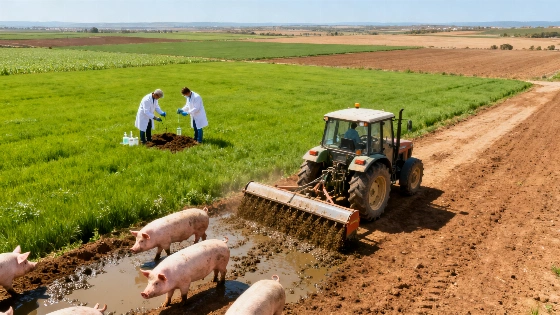
A new scientific project in Aragón reveals that using pig slurry as fertilizer does not cause major shifts in soil microbiota when applied responsibly. The findings offer reassurance for farmers and environmentalists concerned about antibiotic resistance and soil health.
Applying pig slurry as fertilizer has long been a practical, if controversial, solution for managing waste on Spanish farms. Now, a scientific project in Aragón has delivered a clear message: when used under normal management conditions, pig slurry does not trigger drastic or uncontrolled changes in the soil's microbial community.
The PURIBIOTIC project, led by local agricultural and academic partners, set out to examine whether pig manure—rich in microorganisms and sometimes antibiotic resistance genes—could destabilize the delicate balance of soil life. Their findings suggest that, despite the presence of resistance genes in both the slurry and the soil after application, the overall structure of the soil microbiota remains stable.
Inside the PURIBIOTIC Study
PURIBIOTIC brings together the Clúster Español de Productores de Ganado Porcino, i+Porc, the Asociación de Defensa Sanitaria Comarcal Nº2 de Ganado Porcino de Ejea de los Caballeros, and the University of Zaragoza. Over four years (2024–2027), the team is mapping the bacterial profile of pig farms at different production stages and tracking how these microbes and resistance genes move from manure to soil.
The project's full title—'Characterization of the antibiotic resistance profile in the microbiota of pig slurry for environmental protection'—reflects its dual focus: understanding what pig slurry contains and how it interacts with agricultural land. Rather than simply testing the end product, researchers are tracing the origins and pathways of bacteria and resistance genes throughout the farming process.
What Happens When Slurry Hits the Soil?
Pig slurry, largely derived from the animals' digestive tracts, naturally carries a mix of microorganisms and genetic material, including resistance genes. The key question for PURIBIOTIC was whether spreading this slurry on fields would disrupt the soil's microbial ecosystem.
To answer this, the team compared the microbiota of the slurry with that of the soil before and after fertilization. Their results show that agricultural soil is not a passive surface but a dynamic, resilient ecosystem. Even after slurry application, the soil's microbial structure remains largely intact, absorbing changes without losing its overall balance.
Antibiotic Resistance: A Measured Risk
While the study did detect resistance genes in both the slurry and the soil post-application, the presence of these genes alone does not justify unrestricted use. The researchers emphasize that, under controlled and monitored conditions, pig slurry does not cause major or uncontrolled shifts in soil microbiota. The message is clear: responsible management is essential, and the findings should not be interpreted as a green light for indiscriminate spreading.
It's also worth noting that some studies suggest biofertilizers, including those derived from animal waste, can help crops withstand drought. However, understanding both the benefits and potential risks of pig slurry is crucial for sustainable agriculture.
Guidelines for Safe Use
The practical value of PURIBIOTIC lies in its data-driven approach. For farmers and agricultural stakeholders, the key recommendations are:
- Apply pig slurry only under standard, controlled conditions.
- Monitor for resistance genes in both slurry and soil.
- Compare soil microbiota before and after fertilization.
- Recognize that soil is a living ecosystem, not an inert surface.
- Avoid interpreting the study as permission for unrestricted use.
In short, pig slurry can play a role in sustainable fertilization, but only with careful oversight. Turning a useful solution into a new problem through neglect or overuse remains a real risk.
Impact on the Fertilizer Debate
PURIBIOTIC's findings bring clarity to a longstanding debate. The research indicates that, when managed properly, pig slurry does not destabilize the soil's microbial balance. This evidence-based approach helps move the conversation beyond assumptions, focusing instead on real-world impacts and responsible practices.
For Spain's agricultural sector, the message is pragmatic: pig slurry can be a valuable fertilizer without compromising soil health, provided its use is carefully monitored and regulated. As the project continues, its data will help inform both policy and practice in the ongoing search for sustainable farming solutions.