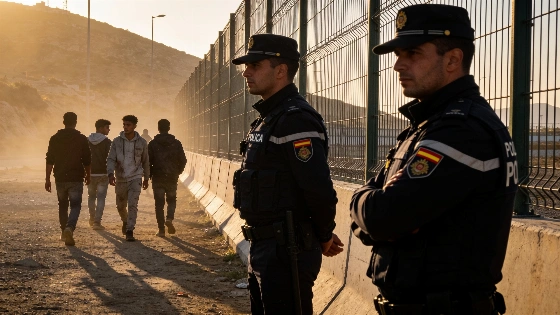
A police report exposes how coordinated online messages and misinformation triggered the mass entry of migrants into Ceuta. Authorities highlight the role of foreign agents and digital planning in the July 2026 border breach.
Spanish police say the mass entry of migrants into Ceuta on July 30 and 31, 2026, was not spontaneous but the result of a carefully organized digital campaign. A confidential report from the Centro Nacional de Inmigración y Fronteras (CENIF) describes how viral social media tactics, amplified by foreign actors, drove the operation. The report alleges Moroccan agents helped guide the movement and that Rabat allowed it to happen. However, Spain's Ministry of the Interior, through police chief Francisco Pardo, has publicly denied that any official police report blames Morocco for planning or carrying out the Ceuta events. This contradiction has fueled debate in Spanish media and politics.
The investigation points to social networks as the main driver of the surge. Starting July 24, platforms like Facebook, Instagram, and TikTok saw a spike in targeted posts calling for a coordinated push at the Ceuta border. Some messages were logistical—"Is there a planned exit?"—while others were direct calls to action: "On July 30, 2026, we will launch an attack on Ceuta." The language was urgent and aimed at mobilizing large groups quickly. Spanish Prime Minister Pedro Sánchez has said that intelligence services found no evidence of direct Moroccan government involvement, instead blaming disinformation on social media and the actions of outside actors, including references to Russia, Israel, and far-right networks.
Several sources indicate that over 70,000–72,000 people entered Ceuta during the July 2026 crisis, with at least 80–90 fatalities reported—significantly higher figures than initially disclosed.
As the crossing date neared, conversations moved to encrypted channels, mainly WhatsApp. The tone became more tactical. Participants discussed switching to handwritten notes to avoid digital surveillance and organized themselves into groups of ten for the crossing. The police report notes that these groups used specific phone numbers to coordinate across multiple chats, acting as organizers rather than just participants. While some reports describe the CENIF document as detailing "almost complete permissiveness" by Moroccan police and non-spontaneous flows, Spain's Ministry of the Interior continues to deny the existence of such an official report. Moroccan authorities have also rejected claims of state coordination, blaming the surge on the spread of misinformation online.
On the day of the breach, digital activity peaked. Real-time updates appeared across major platforms, with messages like "The gate opened this morning" and "Everyone to Castillejos now, we are a thousand and entering." These updates gave others actionable information, encouraging more people to join the crossing. Those who had already entered Ceuta sent back advice, including instructions to claim political reasons for not returning to Morocco and warnings about possible deportations. According to government and local estimates, most who entered have since been returned or moved on, but thousands remain in Ceuta—around 5,000 by Spanish government data, or up to 7,000–10,000 according to local authorities.
Police analysts reject the idea that the campaign was organic. The report calls the operation "professionally planned," involving content experts and automated tools to maximize reach. Investigators identified several phone numbers linked to multiple groups, with some users acting as key message drivers. The scale and coordination, police say, make it "difficult to accept" that the campaign was accidental or unplanned.
The Ceuta crisis has already sparked internal political conflict in Spain, with protests erupting in several cities and local authorities in Ceuta criticizing the national government's response. This demonstrates that the repercussions of the incident have extended far beyond the border itself, fueling broader debates about migration policy and national security.
Three main factors contributed to the sense of a "unique opportunity" to enter Spain: the Throne Day holiday, the misreading of a Supreme Court ruling on hot returns for swimmers, and the spread of false claims about regularization processes for migrants. Police stress that, despite the viral messages, the regularization process was closed and new arrivals would not benefit.
The episode has shaken Spanish politics, raising questions about border security, foreign influence, and the vulnerability of digital platforms to manipulation. The Ceuta incident shows how a well-organized online campaign can quickly lead to real-world consequences at the border. The evidence points to a new phase in migration, where digital coordination and misinformation can overwhelm traditional security measures in days. Spanish authorities now face the challenge of responding to a threat that is as much virtual as physical. The Ceuta case is a warning that border management in 2026 is no longer just about fences and patrols, but also about controlling the information and networks that shape events.