Corruption remains a central issue in Spanish politics. The PP's efforts to challenge the PSOE are limited by its own history. Surveys show voters still associate the PP more with corruption than other parties.
Corruption has returned to the forefront of Spanish politics, with the Partido Popular (PP) facing renewed scrutiny over its past scandals. Despite attempts to position itself as a force for political renewal, the PP continues to be closely linked to corruption in the eyes of many voters, according to recent surveys. This perception is limiting the party's ability to capitalize on the current crisis facing the PSOE, as reported by El País.
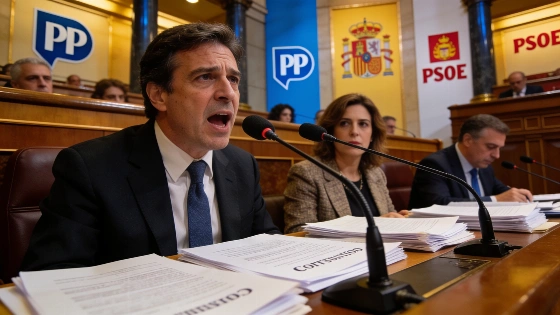
During the final parliamentary session before the summer recess, corruption dominated the agenda. ERC spokesperson Gabriel Rufián listed a series of high-profile PP cases, including “la Gürtel, la Lezo, la Púnica, la Kitchen,” and referenced several former PP ministers and regional leaders either convicted, on trial, or under investigation. The exchange highlighted a persistent dynamic: while the PSOE faces its own scandals, the PP struggles to present itself as a credible alternative on the issue of corruption.
Recent polling data underscores this challenge. The PP remains below its 2023 general election results, even as the PSOE loses support due to ongoing judicial cases. Analysts note that the PP is not the main beneficiary of disillusioned PSOE voters; instead, left-wing parties like Sumar and the pool of undecided voters have seen greater gains. The transfer of votes from PSOE to PP has increased only marginally, despite the PSOE's recent setbacks.
Experts suggest that the lack of a clear anti-corruption champion in the current political landscape is a key factor. In 2015, new parties such as Podemos and Ciudadanos attracted voters seeking political renewal. Today, no party has managed to fill that role. The PP's own record continues to undermine its message, with a recent +Democracia ranking placing it near the bottom for democratic quality—only Vox scored lower among 17 parties.
Surveys reveal that most voters, except those loyal to PP and Vox, still associate the PP more strongly with corruption than the PSOE. Even among its own supporters, the PP struggles to be seen as a credible force for political regeneration. This perception is reinforced in parliamentary debates, where references to the PP's past scandals are frequently used to counter its attacks on the PSOE.
Another complicating factor is the widespread belief in Spain that judicial processes are used as political weapons. Over 65% of citizens believe in the existence of lawfare, with a significant portion viewing left-wing parties as the main targets. This environment makes it even harder for the PP to claim the moral high ground on corruption issues.
Leadership ratings for PP president Alberto Núñez Feijóo have also declined in recent months. Despite the PSOE's troubles, Feijóo has lost ground in key indicators such as trust and approval, and remains behind Pedro Sánchez in overall ratings. This further limits the PP's ability to present itself as a credible alternative.
Some analysts argue that the PP's strategy is not to present itself as a model of virtue, but rather to spread the perception that all parties are equally tainted by corruption. This approach, they suggest, is aimed at demobilizing left-wing voters rather than energizing the PP's own base. The ultimate goal is to secure enough support, potentially in alliance with Vox, to form a government—even if the PP does not significantly increase its own vote share.
For context, Spain has a long history of political corruption cases involving both major parties. The Gürtel case, which led to the fall of the last PP government, remains a reference point in public debate. The PSOE has also faced high-profile scandals, but the PP's legacy continues to weigh heavily on its image. As the political landscape evolves, the ability of any party to convincingly address corruption remains a central challenge. The ongoing association of the PP with past scandals suggests that, for now, its anti-corruption campaign faces significant obstacles.