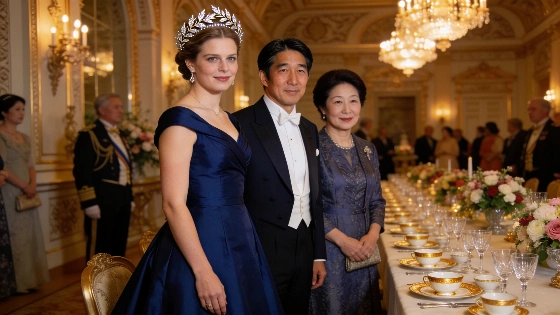
Princess Elisabeth appeared at her first state banquet in Brussels, wearing the laurel tiara of Queen Mathilde. The event, attended by Japan's imperial couple, signals a new era for Belgium's royal family.
Brussels witnessed a significant moment for the Belgian monarchy as Princess Elisabeth, heir to the throne, made her official debut at a state banquet hosted at the Palace of Laeken. The event, held in honor of Emperor Naruhito and Empress Masako of Japan, marked Elisabeth's first appearance at such a high-level diplomatic gathering, underscoring her growing responsibilities within the royal family.
Fresh from completing her master's degree at Harvard University, the Duchess of Brabant returned to Belgium to take on a more prominent public role. For this landmark occasion, Elisabeth chose a navy blue gown with a bateau neckline, complemented by the sash of the Japanese Order of the Precious Crown. However, the centerpiece of her ensemble was the laurel tiara—a historic piece crafted in 1912 by Hennel & Sons, made of platinum and brilliant-cut diamonds. This tiara, gifted to Queen Mathilde by Belgian aristocrats upon her engagement to then-Prince Philippe in 1999, had never before been worn by Elisabeth in public.
The laurel tiara is notable for its versatility, as it can also be worn as a necklace—a detail previously demonstrated by Queen Mathilde at the wedding of the Duke and Duchess of Cambridge in 2011. Until now, Princess Elisabeth had opted for other tiaras at international royal events, including a piece received for her 18th birthday and the Wolfers tiara, a convertible diamond necklace once belonging to Queen Fabiola. At the banquet, Elisabeth also wore diamond cascade earrings borrowed from her mother's collection, further highlighting the significance of the occasion.
The state dinner was not only a debut for Elisabeth but also for her younger siblings, Princes Gabriel, Emmanuel, and Princess Éléonore, who attended their first event of this kind. Notably, Éléonore wore her own new tiara, a gift from their parents, mirroring the tradition established for Elisabeth's milestone birthday. The presence of the entire royal family alongside the Japanese imperial couple emphasized the generational shift underway within the Belgian monarchy.
Elisabeth's increased visibility began earlier in the week when she personally welcomed Emperor Naruhito and Empress Masako at Melsbroek Air Base, a role deliberately entrusted to her by King Philippe and Queen Mathilde to strengthen her international profile after years of study abroad. The official program included private time at the Castle of Ciergnon before culminating in the formal banquet at Laeken, which served as the highlight of the Japanese state visit.
This high-profile event comes amid a broader trend of European royal families preparing their heirs for future leadership, a topic that has drawn attention in recent weeks. For example, recent coverage of public ceremonies and generational transitions, such as the turbulent developments in 'Valle Salvaje', can be explored in more detail through this related report on royal protocol and public expectations.
For context, the Belgian monarchy is among the youngest in Europe, with the current King Philippe ascending the throne in 2013. State banquets are rare occasions where protocol, tradition, and diplomacy intersect, often serving as platforms for heirs to demonstrate readiness for future roles. The Japanese imperial visit to Belgium is part of a longstanding tradition of bilateral exchanges between the two royal houses, reflecting both ceremonial ties and evolving diplomatic relationships in Europe and beyond.