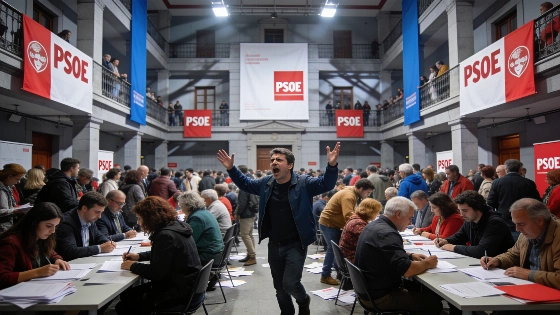
Torrelavega's PSOE has seen its membership jump from 400 to 1,000 in six months. The surge, tied to upcoming primaries, has triggered internal disputes and federal review. Both local and national party leaders are under pressure.
Torrelavega, Cantabria’s second-largest city, is at the center of a political storm after the local PSOE branch saw its membership more than double in just half a year. The number of affiliates soared from 400 at the end of last year to nearly 1,000 by June, a spike that coincides directly with the party’s primary process to select its next municipal candidate. This rapid growth has drawn sharp criticism from within the party, with some members calling the increase “extraordinarily anomalous” and questioning the legitimacy of the process.
The surge in new members has not gone unnoticed by the PSOE’s federal leadership in Madrid. While Ferraz, the party’s national headquarters, has approved most of the new affiliations, it has also annulled an unspecified number of registrations. Party officials insist that all new members must be up to date with their dues and have a genuine connection to Torrelavega, either by residence or employment. Despite these assurances, concerns persist that both main candidates—regional organization secretary Agustín Molleda and local secretary José Luis Urraca—have actively encouraged mass sign-ups to influence the outcome of the primaries.
According to internal documents, the most dramatic spike occurred on May 31, the final day to register for voting eligibility. On that single day, 283 new members joined, pushing the total to 911, not counting the local Socialist Youth. Critics argue this last-minute influx points to coordinated efforts to sway the primary, with accusations that both camps have inflated the rolls. The local leadership has even requested that the federal executive exclude 101 new Socialist Youth members from the primary, citing suspicions that the youth branch was used as a vehicle for electoral gain.
Party veterans recall previous peaks in membership during the 1980s, but note that the current figures are unprecedented for the city. Despite the numerical boom, some long-standing members and staff at the party’s headquarters report little change in day-to-day activity, suggesting that many new affiliates may not be actively engaged. The situation has prompted the municipal leadership to submit a legal and organizational report to the federal Ethics and Guarantees Commission, advocating for the use of the October 2025 census as the only legitimate basis for the primary vote.
Torrelavega’s PSOE branch is now one of the largest in northern Spain, surpassed only by Gijón. For comparison, León’s local party has around 850 members, while A Coruña leads in Galicia with 475. The rapid expansion in Torrelavega stands out even more given that, just a year ago, Cantabria’s total PSOE membership was under 3,000, with 500 in Santander. The city itself has a long socialist tradition, though the current mayor is from the PRC, and the PSOE has held the mayoralty for most of the democratic era.
The controversy in Torrelavega has sparked debate among party officials from other regions, some of whom warn that such practices could set a precedent for similar tactics in upcoming primaries elsewhere in Spain. They point out that if new members are not properly registered as residents, they may not be eligible to vote in municipal elections, raising further questions about the long-term impact of the current surge. The censo for upcoming regional and municipal primaries will close on September 1, a deadline that could see similar disputes arise in other territories.
Party leaders at both the local and national levels have downplayed the controversy, attributing the rise in membership to renewed enthusiasm and the competitive nature of internal elections. However, the scale and timing of the increase have left many within the PSOE uneasy. The situation in Torrelavega echoes broader challenges faced by political organizations during periods of internal contest, where rules and procedures are tested by the ambitions of rival factions. In a related context, the dynamics of local political renewal and organizational strategy have also been observed in other Spanish cities, such as the recent efforts by Real Zaragoza’s leadership to rebuild club identity and community engagement, as detailed in this report on long-term institutional projects.
As the PSOE prepares for its primary vote in Torrelavega, the outcome will likely influence not only the city’s political landscape but also set a tone for internal party processes across Spain. The episode highlights the complexities of balancing democratic participation with organizational integrity, especially in regions where party affiliation can shift rapidly in response to electoral incentives. The coming months will reveal whether the current membership boom translates into lasting engagement or fades after the primaries conclude.