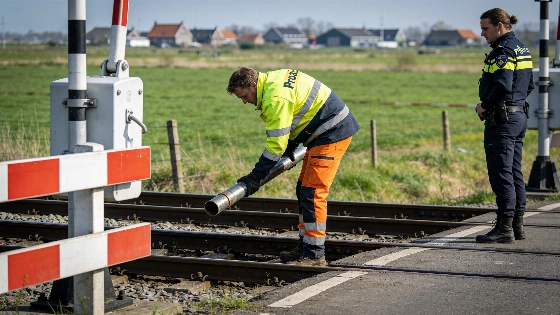
Train traffic in central and northern Netherlands was brought to a standstill after suspected sabotage. Unknown individuals placed pipes on tracks at 27 locations. The incident coincided with Prinsjesdag and triggered a national investigation.
Train service across central and northern Netherlands stopped abruptly on Tuesday morning after a coordinated act of sabotage. The disruption hit during Prinsjesdag, the annual opening of parliament, leaving thousands of commuters and government officials stranded or delayed.
ProRail, which manages the Dutch rail network, reported that unknown individuals placed metal pipes on tracks at 27 locations, mostly in rural parts of the central and eastern regions. These objects triggered technical failures, especially at level crossings, and forced emergency crews to remove them throughout the morning. Most of the pipes have now been cleared, but the timing and scale of the sabotage left authorities searching for answers. According to Euronews and AP News, the safety systems responded as designed: signals turned red when foreign objects were detected, stopping all train movement to prevent accidents.
"In at least one case, a train struck a pipe placed on the tracks, but no injuries were reported, confirming the physical presence of sabotage materials."
— Euronews
Police and the Dutch intelligence agency AIVD have opened a joint investigation. So far, no suspects have been identified and no group has claimed responsibility. ProRail said all evidence points to deliberate human interference, not a technical fault. The fact that the incident happened on Prinsjesdag, when King Willem-Alexander was set to present the government’s 2027 budget, has raised questions about possible motives and the security of national infrastructure. DutchNews.nl reported that authorities have not officially linked the sabotage to an attempt to disrupt the parliamentary event, but the timing has fueled speculation.
Prinsjesdag is the Dutch equivalent of a state of the nation address, drawing political leaders, media, and public attention. This year’s budget plans have already sparked protests, with unions objecting to cuts in social benefits and farmers planning demonstrations in The Hague over nitrogen pollution rules. The sabotage happened as farmers prepared to rally in the capital, adding to an already tense political atmosphere. Reuters noted that the disruption affected routes around Utrecht, Zwolle, Arnhem, and Leeuwarden, with delays spreading across the national network.
ProRail’s teams worked through the morning to remove the pipes and restore service, but the incident showed how vulnerable the rail system can be. Police have not released further details, and the investigation is ongoing. The involvement of the intelligence service underlines how seriously authorities are treating the case, especially given the day’s political importance.
"ProRail warned that the closure of level crossings due to the sabotage could also cause significant delays for road traffic, highlighting the broader impact on public and private transportation beyond the rail network itself."
— AP News
The Netherlands has seen many political protests, but the scale and coordination of this sabotage are unusual. Targeting 27 sites at once suggests planning and intent, not random vandalism. As with other recent incidents where infrastructure became a target for protest, this case shows the risks when political anger spills over into direct action against public systems.
Disruptions like this are rare in Western Europe, where rail networks are essential for daily life and the economy. The Dutch government now faces pressure to improve security and reassure the public that these vulnerabilities will be addressed. The outcome of the investigation will be closely watched, both for accountability and for what it reveals about the intersection of protest, politics, and infrastructure in a country known for its stability.