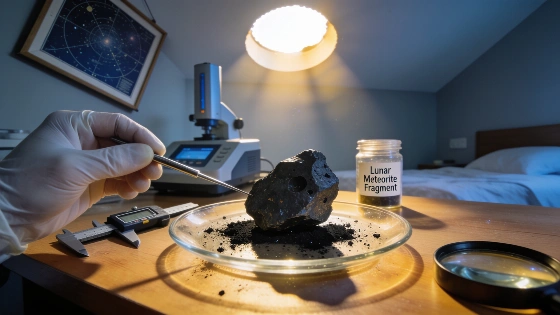
A meteorite that crashed into a New Jersey house was recovered almost untouched. Scientists found ancient salts and organic molecules inside, offering new clues about the early Solar System and the origins of life.
Scientists have confirmed that a meteorite which struck a home in Hillsborough, New Jersey, contains exceptionally well-preserved traces of ancient brines and a wide array of organic molecules. The meteorite, collected just minutes after impact, avoided exposure to Earth's moisture and air, allowing researchers to analyze its minerals and chemistry in nearly pristine condition. This rare find, detailed in Science Advances, is now considered one of the most scientifically valuable meteorites ever recovered after a witnessed fall.
The event unfolded on July 16, 2024, when a bright fireball streaked across the skies above New York at over 51,000 kilometers per hour, followed by a loud sonic boom heard across several northeastern states. Radar and surveillance footage traced the meteorite's path back to the main asteroid belt. During its descent, the rock broke apart, and a fragment weighing just over a kilogram pierced the roof of a Hillsborough residence. The homeowner, noticing a strong sulfur-like odor and black dust in the bedroom, took care to handle the debris with gloves, foil, and glass containers—an action that proved crucial for preserving its scientific integrity.
Subsequent mineralogical analysis revealed the meteorite to be a rare CM1/2 carbonaceous chondrite, a type seldom recovered in such unaltered condition. Only one other meteorite of this class has been observed and collected under similar circumstances, making this an exceptional opportunity to study some of the Solar System's most primitive materials.
Inside the meteorite, researchers identified tiny fragments rich in mineral salts, evidence that highly concentrated brines once existed within its parent asteroid billions of years ago. The slow evaporation of liquid water near the asteroid's surface left behind these salt deposits, resembling brines found in Earth's extreme environments. This discovery aligns the Hillsborough meteorite with samples recently returned by Japan's Hayabusa2 and NASA's OSIRIS-REx missions, which also found signs of water-altered minerals on asteroids Ryugu and Bennu. The presence of brines is significant because they act as natural chemical laboratories, enabling reactions between minerals and organic molecules and keeping essential elements like phosphorus dissolved for extended periods.
Further analysis uncovered a diverse collection of soluble organic compounds, including amino acids and carboxylic acids—molecules considered fundamental to prebiotic chemistry. Isotopic studies of carbon and nitrogen confirmed these compounds are typical of primitive carbonaceous chondrites, supporting the idea that meteorites like this may have delivered key ingredients for life to early Earth. Notably, scientists also detected magnesium organometallic compounds, which may have formed through chemical reactions driven by ancient brines within the asteroid. The distribution of amino acids suggests that many of these molecules originated inside the asteroid itself, not during the meteorite's impact on Earth.
Each new analysis of the Hillsborough meteorite offers a rare glimpse into the Solar System's distant past. Rather than being just a rock from space, it serves as a nearly untouched geological archive of the processes that shaped the planets. The scientific value of such meteorites is underscored by recent research into ancient planetary events, such as the study of mass extinctions and their links to environmental changes, as explored in recent investigations into the Permian-Triassic extinction.
For context, carbonaceous chondrites like the one found in New Jersey are among the oldest materials in the Solar System, dating back over 4.5 billion years. Their study helps scientists reconstruct the conditions that existed before and during planet formation. The discovery of ancient brines and organic molecules in such meteorites strengthens the hypothesis that the building blocks of life may have arrived on Earth from space, carried by similar fragments during the planet's early bombardment. As more meteorites are recovered and analyzed, each provides a new piece of the puzzle about our origins and the dynamic history of our planetary neighborhood.