Margarita Robles used a pre-National Day military briefing to address troops abroad and the Ceuta command. Her message tied overseas operations to Spain’s position on Ceuta and Melilla.
At a military videoconference held ahead of Spain’s National Day, Defence Minister Margarita Robles addressed units serving outside the country and the Comandancia General de Ceuta.
Spain’s military presence abroad is set to remain at its current level during 2026. The plan covers 17 overseas missions, with an average of 3,000 Spanish service members deployed across four continents. Spain is expected to retain a role in NMI in Iraq and in EUNAVFOR Atalanta, although the operation’s force command moved to Portugal on 10 October 2026.
Deployments extend across the Baltic states and Ukraine. Spain also maintains commitments in Romania. Other missions cover Lebanon, Somalia and Iraq.
The command of EUNAVFOR Atalanta changed on 10 October 2026: Portuguese Commodore José João Rodrigues Pedra succeeded Spanish Rear Admiral Francisco Javier Vázquez Sanz as operation force commander.
That is the operational backdrop to Robles’s message.
The call took place on the eve of Spain’s National Day rather than on 12 October itself. Robles said the earlier timing would allow a calmer conversation with the units involved. The Ceuta command joined the meeting exceptionally, giving her a direct opportunity to discuss the city’s military role alongside overseas deployments.
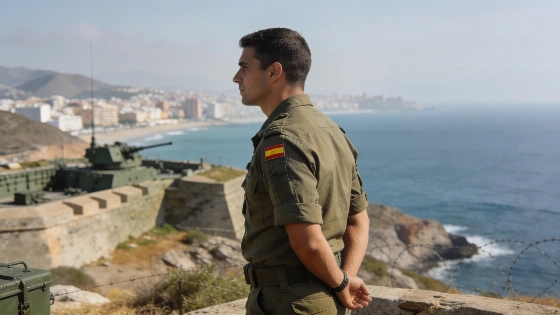
Robles praised what she described as the command’s quiet and professional work under difficult conditions and within the law. She highlighted its surveillance and deterrence duties in support of the local population, saying Ceuta’s residents value that work. Her remarks followed what she characterised as unfair criticism caused by a lack of understanding.
The European External Action Service reported that the European Union was running 20 Common Security and Defence Policy missions and operations in October 2026: 11 civilian, eight military and one mixed initiative. The figure places Spain’s 17-mission deployment plan within a broader European security effort.
The political message was as direct as the operational one.
Robles said there should be no doubt about the Spanish status of Ceuta and Melilla. She presented both cities as an unmistakable representation of Spain, placing territorial defence alongside the missions carried out by Spanish forces in Europe, Africa and the Middle East.
Spain’s overseas commitments include United Nations missions in Lebanon and Colombia. Spanish troops lead the eastern sector in Lebanon. Within NATO, the new force model will give Spain leadership of the FLF-Eslovaquia battlegroup in 2026. The current land contingent in FLF-Letonia will form part of a wider Euro-Atlantic deployment.
The country will also contribute to NATO’s permanent naval forces SNMG and SNMCMG. Its commitments include air policing and surveillance in Eap-Rumania. Spain will provide Baltic air defence through BAP and air defence support in A/T-Turkey.
Within the European Union framework, Spain is present in all military missions on the African continent listed in the government’s plan. Those deployments include the Central African Republic. They also cover Somalia and Senegal.
Operation Atalanta adds a maritime role by combating piracy in the western Indian Ocean and supporting maritime security in the Red Sea. According to the relevant EU decision, the operation continues under its existing mandate, but its operational command passed from Spain to Portugal on 10 October 2026. Spain remains an important participant, with personnel and equipment from the Armada and the Ejército del Aire y del Espacio supporting the operation from the ES-OHQ at Rota Naval Base.
The maritime agenda also includes the protection of commercial navigation. The EU’s EUNAVFOR ASPIDES operation reported support for the safe passage of merchant shipping through vulnerable sea routes.
For Ceuta, Robles tied protection of the city to routine surveillance and deterrence duties performed for its population. For the wider force, she set out a continuing Spanish contribution to NATO, European Union and United Nations missions while maintaining a substantial deployment abroad.
Available official results do not independently confirm the exact number of Spanish service members, the full composition of the 17 missions, participation specifically in NMI or the detailed statements attributed to Robles about Ceuta and Melilla. Those details remain subject to confirmation in an official Spanish Defence Ministry statement or videoconference transcript.