Seville offers just five public recreational pools for its entire population. Many neighborhoods endure power cuts and extreme heat. The city’s pool shortage stands out compared to Zaragoza’s 22 municipal pools.
Seville, a city of 700,000, enters another scorching summer with only five public recreational pools available—one for every 140,000 residents. This is the lowest ratio among major Spanish cities, matching only Madrid, despite Seville’s record-breaking summer temperatures. In contrast, Zaragoza, with a similar population and milder climate, operates 22 municipal pools, offering four times more public access to relief from the heat.
The shortage of public pools in Seville is compounded by frequent power outages in several neighborhoods during peak summer demand. Residents often face up to 24 hours without electricity, making it difficult to cool homes, preserve food, or cook. For many families unable to afford holidays, the lack of accessible pools and reliable power turns daily life into a struggle during heatwaves. According to the latest survey by the Centro de Estudios Andaluces, nearly 43% of Andalusians will not take a vacation this summer.
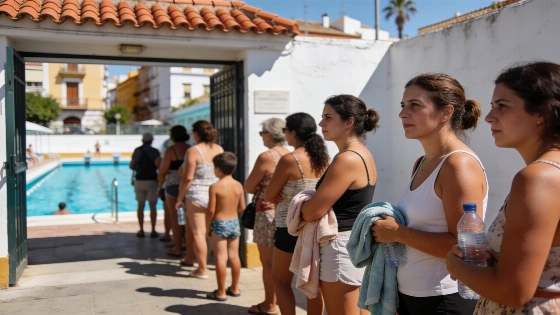
At the Entreflores pool in the Sevilla Este district, queues form before opening as locals seek respite. The facility, with a capacity for 525 users, was recently taken over by the city council after a private club withdrew, increasing the number of public pools from four to five. However, the future of this pool remains uncertain, with local officials yet to confirm if it will stay public next year. The combined capacity of all five public pools in Seville is just 1,500 people—barely 0.2% of the city’s population.
Residents and local politicians have criticized the lack of investment in public recreational infrastructure. Calls for at least one pool per district have grown, especially as Seville’s 11 districts remain underserved. Critics argue that the city’s focus on tourism and private development has left basic amenities for locals behind. The scarcity of public drinking fountains further highlights the city’s limited adaptation to rising temperatures, a measure already adopted in many European cities.
The city council has announced plans to build a new recreational pool for the Triana and Los Remedios neighborhoods next year. However, other projects, such as the Macarena pool, will be indoor facilities without green spaces. Officials acknowledge that surviving Seville’s summer without access to cooling infrastructure is a major challenge. Of the 6,134 new public and semi-public social housing units under construction, about half are planned to include pools.
Comparisons with Zaragoza extend beyond public pools. Seville has a total of 1,999 pools, including private and club facilities—one for every 350 residents—while Zaragoza boasts 4,348, or one for every 161 people. Both cities have similar municipal budgets, but Zaragoza invests €10 million each summer in its pools and is building a 23rd facility. Meanwhile, Seville’s average July and August highs reach 36°C, compared to Zaragoza’s 32°C, according to the national meteorological agency.
Many Seville residents report long waiting lists for pool passes and overcrowding at existing facilities. Some neighborhoods, like Palmete, have available land but no public pools, leaving families with limited mobility or financial means without options. The historical lack of municipal investment is often justified by Seville’s proximity to the coast and the presence of private clubs, but high membership fees and long waiting lists make these inaccessible for most.
Since 1999, Seville has seen both socialist and conservative governments, with each administration citing budget crises or shifting priorities for the slow progress. Some former officials argue that public management has not prevailed over private concessions, resulting in a focus on indoor pools rather than open-air recreational spaces. The cost of building a pool for 500 people is estimated at €5–6 million, but advocates say the real barrier is political will, not funding or space.
In some cases, residents have resorted to renting tourist apartments in their own neighborhoods just to access a community pool during heatwaves. This unusual workaround underscores the extent of the problem and the urgent need for more public recreational infrastructure in Seville.
For context, Spain’s major cities vary widely in public pool provision. While some, like Zaragoza, prioritize open-air pools as climate refuges, others lag behind despite facing harsher summer conditions. The issue highlights broader questions about urban planning, social equity, and adaptation to climate change in southern Europe.