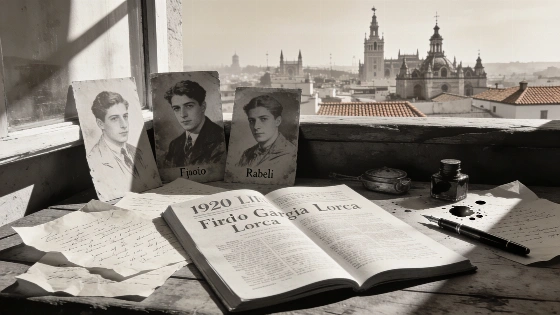
Andalusia is releasing a facsimile of the first 16 issues of ‘Mediodía’, the magazine that launched the Generation of ’27. The project highlights the role of Seville in Spanish literary history. Key figures like Lorca and Alberti contributed.
Seville is commemorating the centenary of ‘Mediodía. Revista de Sevilla’, the magazine that ignited the creative surge of the Generation of ’27. This year, Andalusia will publish a facsimile edition of the magazine’s first 16 issues, spotlighting the publication that gave early voice to writers such as Federico García Lorca, Rafael Alberti, and Luis Cernuda. The initiative, led by the Biblioteca de Andalucía and curated by Eva Díaz Pérez, aims to restore the magazine’s foundational role in Spanish literature.
‘Mediodía’ was not the most famous or longest-running of its era, but it was the first to serve as a testing ground for young writers who would later define 20th-century Spanish poetry. The magazine’s launch in June 1926 marked the beginning of a wave of regional literary journals, including ‘Litoral’ in Málaga and ‘Gallo’ in Granada, each contributing to a vibrant, interconnected cultural scene. According to Díaz Pérez, this period saw a rare spirit of collaboration and a push to highlight creative work from outside Madrid, with each publication influencing the others and shaping a distinct literary atmosphere.
The editorial team behind ‘Mediodía’ included Eduardo Llosent as director, Rafael Porlán as secretary, Alejandro Collantes as administrator, and Joaquín Romero Murube as chief editor. Although intended as a monthly, the magazine’s publication schedule was irregular, with only three issues in 1927 and five in 1928. Over time, its pages featured an expanding roster of influential contributors, including Pedro Salinas, José Bergamín, Fernando Villalón, Salvador Dalí, Emilio Prados, and Lorca, whose ‘Romance con lagunas’ appeared in issue seven. The magazine also published experimental works, such as Ernesto Giménez Caballero’s provocative “fichas textuales” in 1928, reflecting the avant-garde spirit of the time.
Despite its openness to various art forms—literature, music, painting—‘Mediodía’ included only three female authors: Carmen Conde, Ernestina de Champourcin, and Maruja Mallo. The final issue of its first period, number 14, was released in February 1929, featuring a poem by Vicente Aleixandre and works by Francisco Ayala and Ramón Gaya. After a hiatus, the magazine returned in 1933 with a new design but the same price—one peseta. This brief second phase included contributions from Jorge Guillén, Gerardo Diego, Adriano del Valle, Antonio Machado, and a handwritten poem by Juan Ramón Jiménez. A final issue appeared in 1939, reflecting the changing political climate.
The centenary celebrations will culminate in a major exhibition at Seville’s Fábrica de Artillería, scheduled to open in February next year. Organizers hope to draw attention to this pivotal moment in Spanish cultural history, emphasizing the influence of Andalusian creators and the collaborative spirit that defined the Generation of ’27. The exhibition will also highlight the presence of women in these literary circles, noting their greater visibility in other contemporary magazines, such as those featuring Josefina de la Torre, Concha Méndez, and María Zambrano.
Interest in Spain’s literary heritage remains strong, as seen in other cultural milestones like the Sitges Film Festival’s recent focus on Spanish classics and restored works. For example, the festival’s program, which included a tribute to ‘Carrie’ and Spanish cinema, was covered in detail in a recent report on major cultural anniversaries. Such events underscore the ongoing relevance of Spain’s artistic legacy and the enduring impact of early 20th-century innovators.
The Generation of ’27, shaped in part by the pages of ‘Mediodía’, would soon face upheaval. The outbreak of civil war and subsequent exile or death scattered its members, ending a period of extraordinary creativity. The upcoming exhibition and facsimile edition serve as a reminder of a brief but luminous chapter in Spanish culture, when Seville stood at the heart of a literary revolution.
For context, the Generation of ’27 refers to a group of poets and artists who emerged in Spain in the late 1920s, known for blending tradition with avant-garde experimentation. Their influence extended beyond literature to painting, music, and philosophy, and their legacy continues to shape Spanish cultural identity. The centenary of ‘Mediodía’ offers a rare opportunity to revisit the origins of this movement and to recognize the role of regional initiatives in shaping national culture.