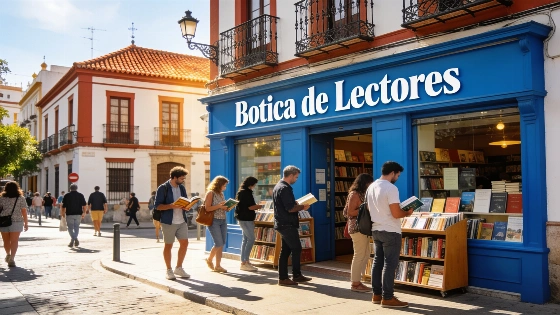
After losing their jobs in a major bookstore chain’s collapse, three friends launched Botica de Lectores. Nine years later, they have opened six stores in Seville, reviving spaces left by others.
In Seville, the independent bookstore Botica de Lectores has just opened its sixth location, marking a remarkable turnaround for its founders. The business was born in 2017 after the collapse of a major Andalusian bookstore chain left its staff unpaid for nearly a year. Three former employees—Maru Rodríguez, Miguel Ángel Neva, and Rafael Rodríguez—decided to invest their unemployment benefits and experience into a new venture, despite warnings from family and friends about the risks of starting a business together.
The first Botica de Lectores store opened in March 2017, taking over a former bookstore site on República Argentina. Within the same year, a second branch appeared just 300 meters away in Los Remedios, each catering to different types of customers. While one location serves as a neighborhood bookstore, the other attracts a broader, more transient clientele. The founders credit their survival to their deep knowledge of the book market, gained from years working at Beta, the chain that went bankrupt.
Expansion plans faced setbacks during the Covid-19 pandemic, which initially boosted local reading but then shifted demand online. Despite these challenges, Botica de Lectores managed to secure a central location in Seville’s historic district in 2023, taking over from the well-known Reguera bookstore after its owner retired. In 2024, they added another branch on Feria street and soon after opened a fifth store in Nervión, near El Corte Inglés. The latest opening in Sevilla Este brings the total to six stores, now employing fifteen people.
Beyond selling books, the company has diversified by launching Fórmula Cultural, an event management business that organizes literary events such as Letras en Off and the Feria del Libro Juvenil de Gelves. In the past year alone, Botica de Lectores hosted around a thousand activities, including 18 active reading clubs. The founders emphasize the importance of making bookstores community spaces rather than just retail outlets.
Despite their growth, the business remains highly seasonal, with sales peaking at Christmas and dropping sharply after January 6. The founders attribute their resilience to professional management and a focus on human relationships with both customers and staff, recalling their own difficult experiences as employees. They note that most new bookstores are not opened by experienced booksellers, which often leads to early closures due to poor management.
Competition from online giants like Amazon remains a significant challenge. The founders point out that Amazon’s shipping discounts, which are not allowed by law in Spain, put independent bookstores at a disadvantage. They reference France’s Lang Law, which enforces a minimum shipping fee to protect small businesses—a measure Spain’s government has considered but not yet implemented.
According to industry data, Spain has seen a steady decline in independent bookstores over the past decade, with many closing due to rising costs and competition from online retailers. However, initiatives like Botica de Lectores demonstrate that with experience, adaptability, and community engagement, independent bookstores can still find room to grow even in a challenging market.