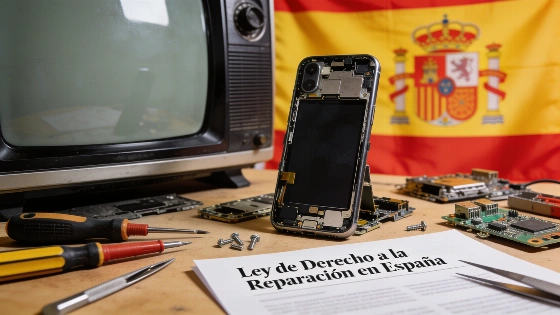
Spain has yet to pass the law that will require manufacturers to offer repairs for out-of-warranty phones, TVs, and appliances. The EU's deadline for national implementation is July 31, 2026, but Spain has not submitted any measures, leaving consumers and brands in limbo.
As of July 31, Spain has not enacted the national law that will force manufacturers to repair out-of-warranty mobile phones, televisions, and other key electronics—a requirement set by the European Union's new right to repair directive. While the EU's Directive (UE) 2024/1799 officially took effect on July 30, 2024, Spain has yet to transpose its provisions into national law, and the official EUR-Lex registry still shows zero measures communicated by Spanish authorities.
The EU has given member states until July 31, 2026, to implement the directive, which aims to make repairs more accessible and affordable for consumers. However, the deadline marks the latest possible date for compliance, not an automatic activation of new rights. Until Spain passes its own legislation, consumers cannot demand these repairs from brands, and manufacturers are not yet legally bound to comply.
What the Directive Demands
Once Spain completes the transposition, manufacturers will be required to offer repairs for a defined list of products—including mobile phones, cordless phones, tablets, televisions, washing machines, dishwashers, refrigerators, dryers, vacuum cleaners, and certain electronic devices—if the consumer requests it and the repair is technically feasible. The service may be free or reasonably priced, and must be provided within a reasonable timeframe. The law is designed to prevent excessive costs or delays from making repairs impractical, supporting the EU's push for longer-lasting, more sustainable electronics.
Brands will also have to supply spare parts, tools, and technical information under fair conditions for each product category. They must publish clear, accessible price lists for common repairs and cannot block service through restrictive clauses, software, or components without legitimate justification. Importantly, manufacturers cannot refuse repairs simply because a device was previously serviced by another workshop or fitted with compatible parts that meet regulatory standards.
Which Devices Are Covered?
The right to repair will not apply to every electronic device. The directive's annex specifies the categories subject to EU repairability requirements, focusing on widely used consumer electronics and household appliances. Each group is tied to its own technical regulations, and the obligation to repair will only last as long as EU rules require spare parts to be available—typically between five and ten years, depending on the product.
This new regime will coexist with existing product guarantees and consumer rights. Repairing an item outside its warranty period is a separate process from making a claim for lack of conformity. For discounted goods, the current guarantee rules remain in force.
Impact on Warranties and What Consumers Can Do Now
The directive also introduces an incentive for choosing repair over replacement during the legal warranty period. If a consumer opts for repair while the product is still under warranty, the seller's liability will be extended by twelve months—once per item. This benefit will apply to goods purchased from July 31, 2026, onward, and sellers must inform buyers of this option before resolving any defect. The EU plans to launch a platform in 2027 to help consumers find repair services and refurbished products.
Until Spain enacts and communicates its national law, consumers are advised to keep invoices, model and serial numbers, and technical diagnoses. They can request written estimates, expected repair times, and specific reasons for any refusal from manufacturers. This documentation will be crucial for asserting rights once the Spanish regime is in place, and for checking whether a device is covered and for how long repairs must be offered.
While Spain's delay in passing the right to repair law leaves consumers waiting, the broader European trend toward sustainability is already influencing industry standards. The push for more durable, repairable products is reshaping expectations for both brands and buyers. For those interested in how European innovation is impacting daily life, the recent opening of a unique water coaster near Madrid, as covered in this report on new attractions in Spain, highlights the country's ongoing adaptation to EU-driven changes.