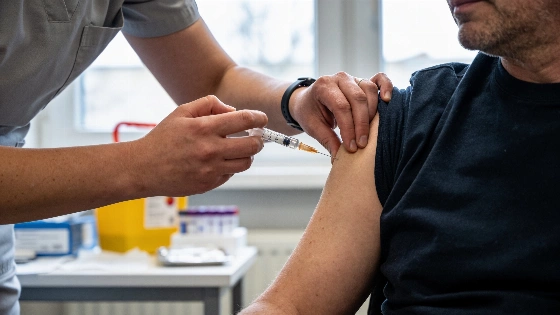
Spain is setting dates for the 2026-2027 flu and COVID-19 campaign. Flu infections have tripled since last year, and surveillance data show the season is starting early. Regional calendars now set the dates for priority groups.
During 7–13 September 2026, primary care flu positivity reached 8.2%, according to surveillance by the Carlos III Health Institute. That is about twice the rate recorded in the same week a year earlier. The epidemic threshold had not yet been crossed.
The Ministry of Health recommends starting immunisation in the final week of September and continuing through October. Each autonomous community sets its own timetable. Vaccine supplies, local health data and the organisation of regional services all affect the dates.
There is no single national opening day.
The first appointments are reserved for people most at risk of serious complications. The main flu target group includes people aged 60 and over, children from six months to five years, pregnant women and patients with diabetes, morbid obesity, chronic cardiovascular disease, neurological disease, respiratory disease or kidney disease. The list also covers people with cancer or immunosuppression.
Aragón is extending publicly organised flu vaccination to children up to 11 years old. Its programme begins with residents and staff in residential centres before expanding to children and other priority groups.
Residents of care homes and disability centres are also included. The same applies to people with Down syndrome or other cognitive dysfunction, coeliac disease and other listed risk conditions. Children aged between five and 18 who receive prolonged treatment with acetylsalicylic acid are covered too. Flu can precede Reye’s syndrome in these cases.
Health workers and emergency workers come next. The priority list also includes members of the State security forces, firefighters and Civil Protection staff. Carers and household members of vulnerable people can receive the vaccine as well.
Nursery and early-years education staff are included. So are workers who have direct contact with animals or their secretions on farms and livestock holdings.
COVID-19 vaccination is being organised alongside flu immunisation in most communities. The recommended groups are broadly similar. They include people over 60, children with risk conditions, residents of institutions, pregnant women, healthcare staff and people who live with or care for vulnerable individuals.
Surveillance by the Carlos III Health Institute recorded an 8.2% flu positivity rate in primary care during 7–13 September 2026, about twice the level recorded in the same week a year earlier. The epidemic threshold had not yet been exceeded, while the World Health Organization reported global flu positivity of 10% in week 37 and stable, low SARS-CoV-2 activity.
Eligible people can receive both vaccines at the same appointment if supplies are available. The Ministry of Health says current evidence has found no difference in immune response or adverse reactions between giving the vaccines together and giving them separately.
Other vaccines can be given at the same appointment. No waiting period is needed when injections take place on different days.
That part is simple.
Several regions have already published detailed calendars. Galicia starts on 28 September in care homes and disability centres. Child immunisation begins there on 13 October.
Aragón also starts on 28 September. Its first groups are residents and workers in residential centres, pregnant women and healthcare staff. Children follow from 5 to 19 October. People over 80 and high-risk groups begin on 19 October. The remaining target groups start on 3 November.
Aragón is extending its regional flu campaign to children up to 11 years old.
Andalusia begins on 1 October in residential and disability centres. The same date applies to children from six months to almost five years. Dependent people and those over 80 follow on 7 October. People over 70 and adults with illnesses begin on 14 October. People over 60 and security forces follow on 21 October.
Asturias also starts on 1 October. Its first groups are residents and children from six months to 13 years. People over 80 begin on 13 October. Other priority groups follow on 26 October.
The sequence widens in stages.
Several other communities start on 28 September. Cantabria begins in care homes. The Basque Country starts in residential centres and for children aged six to 59 months. The Valencian Community begins in residential centres, disability centres and schools.
Castilla y León starts on 1 October for children and institutionalised people. Madrid opens on 5 October for people over 60 and children from six months to seven years. Other target groups follow on 19 October.
Castilla y León has reported 806,650 flu vaccine doses for the 2026-2027 campaign. The total expenditure is €9.55 million. The order includes an intranasal vaccine for children aged 24 months to 11 years.
Catalonia starts risk-group vaccination on 5 October. It opens vaccination to the rest of the over-60 population on 26 October. From 16 November, people can receive the vaccine without an appointment.
La Rioja begins its flu and COVID-19 programme in residential centres on 21 September. Murcia starts in care homes on 18 September. It expands the programme to people over 60, pregnant women and risk groups on 21 September.
The regional timetable also includes separate respiratory syncytial virus measures in La Rioja, Murcia and the Canary Islands.
Some dates are still missing.
Castilla-La Mancha, Navarra, the Balearic Islands, Ceuta and Melilla have not announced a start date for the general campaign. Extremadura has scheduled school vaccination with an intranasal vaccine from 1 to 15 October. The Canary Islands have published respiratory syncytial virus dates but not dates for flu and COVID-19.
The campaign continues until the end of the season. In most communities, that means December or January. Catalonia will keep vaccination available until March. The Ministry of Health says doses will remain accessible throughout the flu season.
Appointments can be requested through each community’s digital platform, by telephone or directly at a health centre.
Residents should check their regional health service rather than wait for a national date. The staggered system gives vulnerable people and frontline staff earlier access. General availability comes later.
Flu activity is rising early, and COVID-19 is still circulating. Regional dates therefore determine when people can receive protection. The same need for clear regional coordination has appeared in another regional dispute.
Check the local date. Book through the authorised channel.