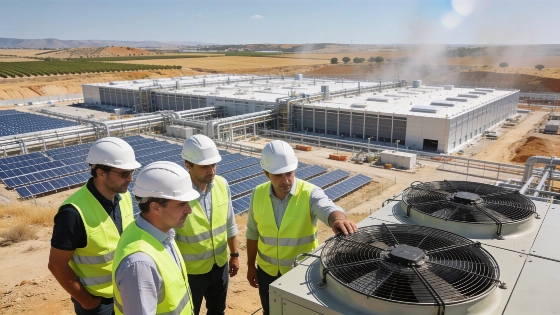
Spain’s bid to host a major European AI gigafactory in Móra la Nova hinges on strict sustainability criteria and the ability to operate efficiently during the region’s extreme summer heat. The project’s environmental plan is under scrutiny as Brussels weighs proposals.
Spain’s ambition to host a flagship European artificial intelligence gigafactory in Móra la Nova, Tarragona, is entering a critical phase. The project, which would combine a main site in Catalonia with operational support from San Fernando de Henares, must now convince Brussels that it can meet some of the continent’s toughest environmental standards—despite the punishing summer temperatures of the Ribera d’Ebre.
The European High Performance Computing Joint Undertaking (EuroHPC) will close its call for proposals on November 12, 2026. To even be considered, candidates must score at least five out of ten points in sustainability and energy efficiency. This threshold is non-negotiable, and for Móra la Nova, where temperatures soared to 44.1°C this July, the challenge is especially acute.
Environmental Demands
Brussels is not accepting vague promises. Each proposal must include a detailed annual plan with measurable targets for energy and water use, as well as emissions. The evaluation will focus on two key metrics: Power Usage Effectiveness (PUE), which compares total energy consumption to that used by computing equipment, and Water Usage Effectiveness (WUE), which tracks water consumption. Only projects with a PUE of 1.10 or lower and a WUE of 0.20 or less will receive top marks. Full renewable energy coverage, matched to hourly demand, is also required for the highest rating.
The Móra la Nova team is proposing closed-loop cooling, strict water limits, renewable energy sourcing, and acoustic insulation to minimize both evaporation and noise for nearby residents. However, these commitments must be backed by concrete figures, contracts, and timelines. The project will also need to show how it can maintain performance during droughts, heatwaves, or grid restrictions—issues that have shaped public acceptance of similar data center investments in Aragón.
Heat as a Technical Hurdle
The region’s climate is a central concern. The site must demonstrate not just annual averages, but also how cooling energy spikes during the hottest months. EuroHPC requires seasonal PUE calculations for both summer and winter, ensuring that strong annual numbers do not mask poor summer performance. The European Code of Conduct for data centers, cited in the project’s documentation, recommends low ambient temperatures for optimal efficiency—something Móra la Nova cannot count on. To compensate, the project will need advanced cooling technology, careful load management, and extremely low water consumption. So far, details on annual water limits, sources, and final system architecture remain unclear.
Power Supply and Growth
The gigafactory’s energy needs will ramp up in phases, starting with a maximum of 55 MW and potentially reaching 150 MW by 2029–2030. An INCASÒL protocol has already identified the need for at least 150 MW, exploring options such as solar parks, battery storage, and renewable supply contracts. However, these are preliminary plans, not binding agreements. The project must prove it has secured grid capacity, renewable sources, and storage for each stage of development. If selected in early 2027, EuroHPC expects the facility to be operational within 18 months. Construction could generate significant demand for skilled trades, especially in electricity, HVAC, civil works, and maintenance, though no official job estimates have been released for Móra la Nova.
Local Acceptance and Transparency
The Ribera d’Ebre has long hosted energy-intensive infrastructure and is currently debating new wind and solar projects. After an initial public investment of €720 million, the consortium will need to attract private capital, with the government estimating up to €5 billion could be mobilized. Ownership is split between SETT (47.99%), the Generalitat (1%), and private partners including Telefónica, ACS, Santander, and Multiverse. Local acceptance may hinge on the publication of detailed environmental data—maximum consumption, noise levels, water sources, and renewable contracts. Agreements to reuse waste heat, as seen in other European projects, could also play a role in public perception.
Spain’s proposal remains in competition, not yet awarded. The selection process will conclude in early 2027, and until then, every sustainability claim must be backed by verifiable technical documentation. The scrutiny facing Móra la Nova echoes the rigorous standards applied to other major science projects, such as the Deep Synoptic Array in Nevada, which also had to demonstrate its environmental and operational credentials before moving forward. For the Ebro Valley, the outcome will shape not only the region’s economic future but also its environmental legacy.