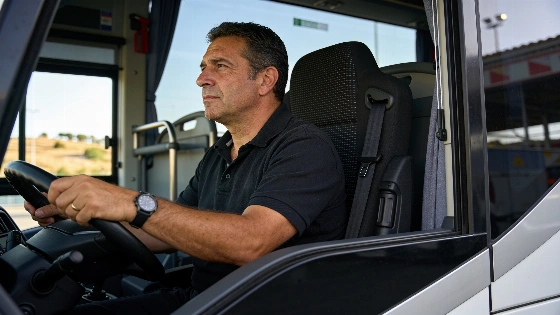
Jordi, a veteran bus driver, shares the realities of his profession: long days, regional pay gaps, and the choice to return home each night over higher international wages. His story highlights the pressures and decisions facing Spain’s drivers.
Jordi has spent over 15 years behind the wheel of long-distance buses in Spain, but the hardest part of his job isn’t the hours or the kilometers—it’s the sense that few people understand what the work truly demands. “People don’t put themselves in your place,” he says, recalling a New Year’s Day spent 15 hours away from home. For Jordi, the job is a constant negotiation between time, money, and personal life.
Speaking on the podcast Rutas de Éxito, Jordi describes a profession under pressure. He covers regular routes, rarely exceeding 600 kilometers in a day, and while the base salary for drivers is around €1,600, his net pay typically reaches €2,500 to €2,600 once allowances and bonuses for distance services are included. Yet, he insists, “We’re in a period where we’re losing a lot of money.” Despite years spent on international routes, Jordi now prefers to sleep at home every night, even if it means forgoing the highest-paying assignments.
For those without family ties or major responsibilities, Jordi admits the discretionary sector—touring across Europe—can be lucrative. “My brother used to make €9,000 a month; now it’s the same work for almost half the money,” he notes. Urban transport, he says, is the best-paid segment, with drivers earning between €2,000 and €2,400 for seven-hour shifts, and the added perk of seeing a new place each day. But pay varies sharply by region: a driver in Barcelona can expect more than one in Lleida or Zaragoza. Jordi also points to industry practices that erode earnings, such as companies refusing to pay for airport waiting hours or manipulating schedules to cut costs.
Official figures back up his claims. In Madrid, a city bus driver for EMT earned €36,835.38 gross in 2021, while the 2022–2023 agreement set the base at €1,844.08 per month, or €65.86 per day. The risks are real, too. Jordi lost a colleague in a road accident, a tragedy that changed his approach to the job. “Now I drive at 100 km/h, sometimes less. What do I lose—ten minutes? I gain peace of mind. You leave for work today, but tomorrow, who knows if you’ll make it back.”
Jordi’s experience echoes the challenges faced by many in Spain’s transport sector, where personal choices often outweigh financial incentives. His story also resonates with others who have changed careers for stability or family life, such as Sandra Ruiz, who rebuilt her life as a truck driver in Valencia after leaving engineering in Venezuela—a journey detailed in this report on career transitions in Spanish transport.
According to data from elespanol motor, the profession remains demanding, with pay and conditions shaped by region, company, and the willingness to sacrifice time at home. For Jordi, the decision is clear: the comfort of returning home each night outweighs the promise of higher pay abroad, even as the sector continues to evolve.