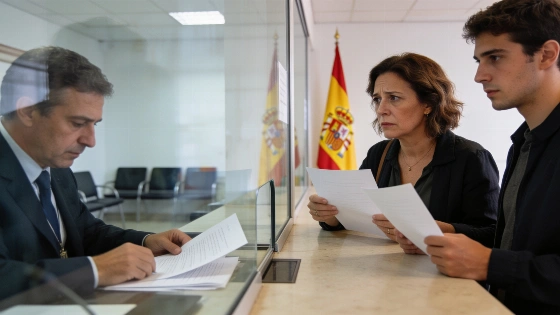
Spain’s Supreme Court has suspended the right to vote for hundreds of thousands who gained citizenship through the 2022 memory law. The decision targets new entries in the overseas electoral roll and leaves their political rights in limbo.
Spain’s Supreme Court has frozen the voting rights of people who recently became Spanish citizens under the 2022 Law of Democratic Memory. On 10 September 2026, the court ordered a halt to their registration in the Censo Electoral de Residentes Ausentes (CERA), which means they cannot vote from abroad just as the next elections approach.
This decision affects more than 400,000 people who have been recognized as Spanish citizens since the law took effect. Their names were about to be added to the overseas electoral roll, but the court’s move has left them in legal uncertainty. There is no clear way for them to appeal as a group, and Spanish law has no precedent for blocking rights from such a large group at once.
According to Spanish media, estimates of those potentially affected by the court's decision range from 333,696 to as many as 2.7 million, depending on whether only those already registered in CERA or all eligible under the law are counted.
The legal dispute began when a party challenged the Central Electoral Board’s refusal to clarify the rules for granting nationality. But the Supreme Court did not address that refusal directly. Instead, it suspended the effects of a 2022 instruction from the Directorate General of Legal Security and Public Faith—an act that had not been formally challenged in court. Dissenting magistrate Millán Herrandis questioned the logic and legality of this approach.
The court justified its decision by citing a possible risk to electoral transparency from the sudden increase in CERA registrations. The majority argued that this could threaten future elections, even though no specific problems have been reported and no elections are currently scheduled. For those affected, the result is immediate: they lose the right to vote, even though their citizenship is fully recognized and uncontested.
Spanish law does not allow for stripping nationality or its rights from a group all at once. Each case would normally require an individual legal process, with the right to defense and judicial review. The court’s order bypasses these protections, imposing a blanket restriction without the usual safeguards. The decision also makes no mention of Article 42 and Article 68.5 of the Constitution, which protect the rights of Spaniards abroad and their descendants.
According to EFE and BBC Mundo, the Supreme Court's suspension does not affect all new citizens equally: those who can provide consular documentation proving their ancestor was exiled for political, ideological, or religious reasons retain the right to register and vote abroad, provided they meet the law's requirements. This exception highlights the ongoing debate over evidentiary standards and the practical impact of the court's decision on different groups within the diaspora.
The controversy goes back to the 2022 instruction, which made it easier for descendants of exiles to prove their case by presuming exile for anyone who left Spain between 1936 and 1955. This was meant to help those who could not produce documents lost during war and displacement. Critics say this presumption is too broad, but the alternative would be to deny rights to people affected by past injustice. The earlier 2008 instruction required stricter proof and individual review, but the 2022 version prioritized access, making it more vulnerable to legal challenges.
Politics are a clear part of the dispute. The legal challenge was brought by a party focused on questioning the legitimacy of these new nationalizations, not on protecting the census. As the dissenting magistrate pointed out, public interest is not just about clean elections but also about making sure recognized citizens can exercise their rights unless a court rules otherwise. Other European countries, like France, Italy, and Portugal, have created special electoral districts for their diaspora. In Spain, critics of the memory law have not proposed similar solutions, preferring confrontation over reform—a pattern seen in other recent disputes, as reported earlier.
Spain’s constitution was designed to prevent collective denationalization and mass loss of rights without due process. The Supreme Court’s temporary order, even if not final, sets a troubling precedent. The group recognized by law has been excluded from political life by a judicial shortcut that ignores constitutional protections and the reality faced by descendants of exiles. This episode exposes both the legal weaknesses of the 2022 instruction and the willingness of some to use those gaps for political aims, leaving Spain’s commitment to individual rights and historical justice in question.