A Swiss company has successfully installed solar panels between active railway tracks, generating clean energy without taking up farmland or rooftops. Over 11,000 trains have passed above the panels without incident, marking a breakthrough in solar infrastructure.
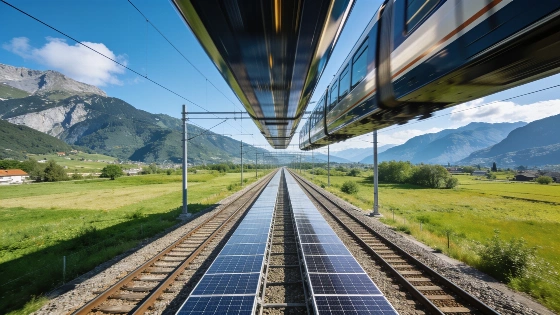
On a 100-meter stretch of railway in Buttes, in Switzerland’s Neuchâtel canton, a new kind of solar plant is quietly rewriting the rules of renewable energy. Since April 2025, more than 11,000 trains have rolled over a line of solar panels installed directly between the rails—without a single safety or maintenance incident reported, according to Swissinfo.
The project, led by the Swiss startup Sun-Ways, addresses one of the biggest challenges facing solar energy: the scarcity of available space. Instead of competing with agriculture, nature reserves, or urban rooftops, Sun-Ways uses existing railway corridors, leaving the primary function of the tracks untouched while generating electricity in parallel.
Solar Power Without Land Loss
The pilot installation features 48 photovoltaic panels, each rated at 380 W, for a total capacity of 18 kWp. The panels are mounted between the rails, designed to withstand the vibrations and airflow from passing trains, which can reach speeds of up to 90 km/h on this section. The French rail operator SNCF is closely involved in the technical evaluation, monitoring everything from glare and panel placement to maintenance and the accumulation of dirt.
Since May 2025, the system has delivered over 16,000 kWh to the local grid, despite a month-long pause due to snow and technical work. Sun-Ways estimates that, if deployed across suitable sections of the Swiss rail network, the technology could eventually supply up to 1 billion kWh annually—enough to power tens of thousands of homes.
Removable Design for Rail Operations
One of the system’s key innovations is its modular, removable design. Railway maintenance often requires direct access to the tracks for inspections, sleeper replacements, or welding. Sun-Ways founder Joseph Scuderi explains that a six-meter module, consisting of three panels, can be disconnected and removed from the grid in about 10 minutes. Specialized machinery developed by Scheuchzer, a railway engineering firm, streamlines both installation and removal, making large-scale deployment more feasible.
Concerns about dirt and debris have also been addressed. While Sun-Ways initially considered a brush-based cleaning system, the airflow generated by passing trains has proven effective at keeping the panels clear of dust, reducing the need for manual intervention.
Scaling Up: The Next Challenge
Despite the promising results, the project faces a significant technical hurdle: efficiently transporting the generated electricity over longer distances. Julien Pouget, associate professor at the University of Applied Sciences of Valais, notes that stretches longer than 500 meters require specialized electrical infrastructure to boost voltage and minimize losses.
International interest is growing. SNCF will continue monitoring the Swiss pilot until at least April 2028, while discussions are underway with Rete Ferroviaria Italiana and partners in Asia. Sun-Ways is working to shorten the experimental phase and secure final regulatory approval.
Innovative uses of existing infrastructure are gaining attention across Europe, as highlighted in a recent analysis of how overlooked features in everyday appliances can have a major impact on efficiency—such as the hidden tab in washing machines that affects laundry results.
As the Sun-Ways project moves forward, its success could signal a new era for solar energy—one where clean power is generated not by taking land, but by reimagining the spaces we already use every day.