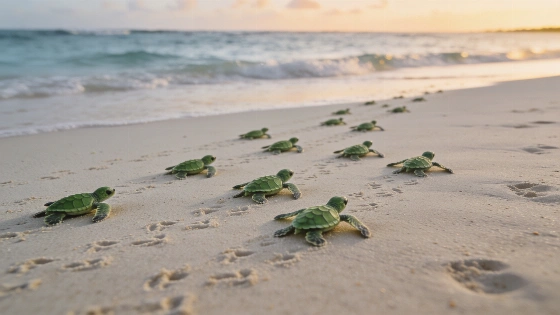
Over 54,000 green turtle hatchlings emerged from Tetiaroa’s beaches this season, shattering previous records. Intensive monitoring and targeted protection have transformed the atoll into a rare sanctuary for a species under global threat.
This season, more than 54,000 green turtle hatchlings emerged from the sands of Tetiaroa, the highest number recorded since monitoring began in 2007. The sharp increase in successful nests has made this remote Polynesian atoll—once owned by Marlon Brando—a rare refuge for a species under pressure worldwide.
Still, the actual number for the 2024–2025 season is 15,614 hatchlings, not the 54,264 reported in some media. This figure, confirmed by Tetiaroa Society and Te mana o te moana, comes from systematic field monitoring: counting empty eggshells and observing nests directly. Conservation groups recognize it as the most reliable estimate.
Seasonal monitoring on Tetiaroa is conducted from September to March each year, allowing for consistent year-to-year comparisons and tracking of long-term trends.
Relentless fieldwork
These numbers are the result of steady, hands-on work. In the latest season, researchers counted about 113 nesting females, 161 nests, and over 430 female tracks or emergences on the beaches. This is part of a regular, months-long program, not a one-off survey, as Tetiaroa Society reports.
Each turtle is identified with photos, flipper tags, and genetic samples. This careful tracking, standard in marine research, lets scientists follow both population trends and individual turtles over time. During the season, the team also rescued 26 weak or injured hatchlings; eight were still in rehabilitation at the time of reporting.
Brando’s vision and the atoll’s transformation
Tetiaroa’s shift into a conservation site has an unusual backstory. Marlon Brando first visited in 1961 while filming Rebelión a bordo. Drawn to the island, he began negotiations to buy it, finalizing the purchase in 1966. Brando wanted to create a low-impact reserve that would serve as both a scientific base and a place for education—not just a private retreat.
Tetiaroa is now considered one of the most successful green turtle nesting sites in French Polynesia, largely due to the removal or strict control of invasive predators such as rats, which has significantly improved hatchling survival rates.
Tetiaroa Society
Brando’s early efforts included a small hotel in the 1970s, but the project struggled financially and was hit by storms. After his death in 2004, his estate partnered with hotelier Richard Bailey to try a new approach: a tightly managed eco-resort, The Brando, alongside a research station run by Tetiaroa Society. Since 2014, this partnership has combined tourism, science, and conservation in a way rarely seen elsewhere in the Pacific.
Protecting the beaches
The turtle monitoring program relies on nightly patrols, nest mapping, and constant observation. Teams identify nesting females, record nest sites, measure incubation conditions, and track hatching rates. They also watch for threats, from rising sand temperatures to invasive predators. Camera traps have shown that rats, introduced long ago, prey on hatchlings as they emerge. Removing these predators has become a priority, helping not just turtles but also seabirds, crabs, and native plants.
Climate change brings new risks. Rising sea levels, coastal erosion, and hotter sand threaten both nests and the balance of male and female hatchlings. Tetiaroa’s beaches remain mostly untouched, giving turtles rare access to undisturbed nesting grounds—something lost in much of the world.
Beyond the sand
The biggest dangers come after the turtles reach the ocean. Satellite tracking of 41 marked turtles shows adult females travel as far as Fiji to feed, while juveniles stay closer to shore. Outside the protected atoll, turtles face accidental capture in fisheries, plastic pollution, boat strikes, and habitat loss. The 15,614 hatchlings counted this year are only those that made it out of the nest; few will survive to adulthood.
As with any long-term ecological project, real success will only be clear over time. This season’s record numbers reflect years of work by scientists, local staff, and volunteers. The future of Tetiaroa’s turtles depends on continued vigilance, flexible management, and the return of nesting females. Nearly sixty years after Brando’s purchase, the atoll is less a Hollywood footnote than a working example of what determined conservation can accomplish with space, resources, and steady commitment.