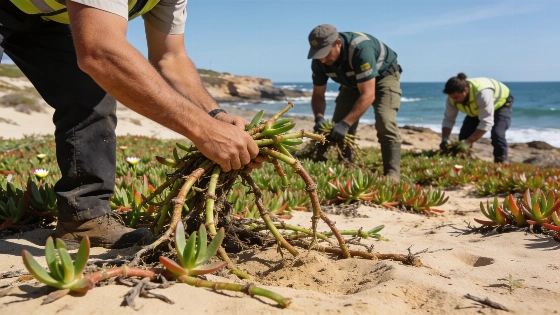
Carpobrotus edulis, once planted to stabilize soil, is now an aggressive invader along Spanish and Californian coasts. Its rapid spread is forcing authorities to use satellite monitoring and costly removal efforts to protect fragile ecosystems.
When Carpobrotus edulis first arrived from South Africa, it was seen as a practical solution for stabilizing railway embankments and roadsides in California. Over a century later, this succulent—better known as the ice plant—has become a dominant force along coastlines, overrunning dunes, cliffs, and grasslands from California to Spain. Its thick, creeping stems can grow up to 90 centimeters a year, forming dense mats that smother native vegetation and alter the landscape.
Originally valued for its ability to hold sandy soils in place, Carpobrotus edulis has proven too effective. Its rapid vegetative growth and prolific seed production allow it to colonize new areas quickly. Once established, the plant’s intertwined stems and shallow roots create a living carpet that blocks sunlight and outcompetes local flora. The impact is not limited to plants: as the ice plant changes soil composition and traps sand, it disrupts the natural movement of dunes and reduces habitat for wildlife adapted to open, shifting environments.
In Spain, the ice plant is now a familiar sight along the Mediterranean and Atlantic coasts, where it goes by names like uña de gato or hierba del cuchillo. Its spread is particularly problematic in protected dune systems and coastal cliffs, prompting its inclusion in the Spanish Catalogue of Invasive Alien Species. This listing brings strict controls on its possession, transport, and sale, and has led to targeted removal campaigns in sensitive areas. However, eradication is challenging: even small fragments left behind can take root and start new colonies, requiring careful extraction and ongoing monitoring to prevent regrowth.
California faces similar challenges. The plant’s introduction by railway companies and later by highway authorities seemed logical at the time, given its drought tolerance and resistance to salty air. For decades, it was also popular as an ornamental groundcover. But its ability to spread both by seed and by rooting from stem fragments has made it nearly impossible to contain. Animals such as rabbits and deer help disperse its seeds, and once several plants meet, their branches weave together into impenetrable mats. This pattern mirrors the difficulties seen with other invasive species, where early intervention is crucial to avoid long-term ecological damage.
The ecological consequences are significant. According to the California Invasive Plant Council, Carpobrotus edulis is now classified as a high-impact invasive species. Its dense growth shades out native seedlings and shrubs, while its decomposing leaves and stems gradually enrich the sandy soil with organic matter—conditions that can favor further invasions by non-native plants. Research published in Biological Conservation has shown that even after removal, soils previously invaded by the ice plant remain altered, making it harder for native dune species to reestablish and opening the door for opportunistic weeds.
One of the most profound effects is on the natural dynamics of coastal dunes. These landscapes are shaped by wind and waves, with constant movement of sand creating habitats for specialized plants and animals. The ice plant’s thick mats stabilize the sand, halting this movement and transforming open, shifting dunes into static, vegetated areas. This change reduces nesting and feeding grounds for birds and other wildlife that depend on open sand. Restoration projects now have to address not only the removal of the invasive plant but also the recovery of the original dune processes and species.
Given the scale of the problem, manual removal is labor-intensive and expensive. In California, authorities have turned to technology for help. The National Center for Ecological Analysis and Synthesis at the University of California, Santa Barbara, has launched a project using satellite imagery, aerial surveys, and machine learning to map and track the spread of Carpobrotus edulis. This approach is being tested in the Jack and Laura Dangermond Preserve, where the goal is to monitor over 300 acres of infested land. The data helps direct removal teams to the most urgent hotspots and assess the effectiveness of restoration efforts over time.
Spain’s coastal managers face similar hurdles. After removal, native plants must be reintroduced quickly to prevent the ice plant from reclaiming bare ground. The process is slow and requires ongoing vigilance, as any lapse can allow the invader to return. The experience echoes other ecological battles, such as the successful eradication of invasive fish in the Pyrenees, which led to the recovery of native species and clearer waters—a story detailed in this report on the restoration of Pyrenean lakes.
The case of Carpobrotus edulis is a cautionary tale about well-intentioned introductions gone awry. What began as a solution to erosion has become a persistent threat to some of the most fragile and unique coastal habitats in Spain and beyond. As authorities refine their strategies, the challenge remains: restoring balance to landscapes transformed by a plant that refuses to stay in its place.