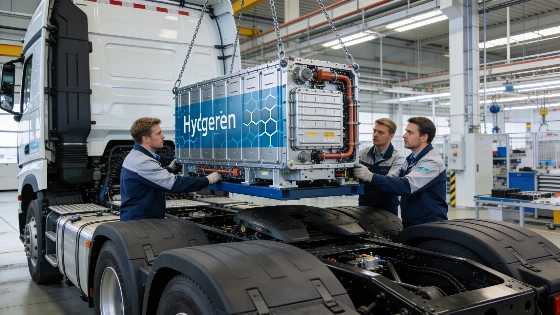
Toyota has signed a binding agreement with Volvo and Daimler Truck to become an equal partner in cellcentric, aiming to accelerate hydrogen fuel cell development for heavy transport. The new system promises double the durability and improved efficiency, with European rollout planned after 2026.
Toyota has taken a decisive step in the hydrogen race, signing a binding agreement with Volvo and Daimler Truck on July 27, 2026, to become an equal partner in cellcentric. This move, still pending regulatory approval, will give Toyota a one-third stake in the joint venture, which focuses on developing and manufacturing fuel cell systems for heavy-duty vehicles and other demanding applications.
The partnership marks a strategic shift for Toyota, which will now work alongside two of Europe’s leading truck manufacturers to scale up hydrogen technology. By joining cellcentric, Toyota brings decades of expertise in fuel cell innovation, while the venture will continue to operate independently. The collaboration is designed to accelerate the rollout of hydrogen-powered solutions for trucks, buses, and other sectors where battery-electric options face technical limits.
Toyota’s Hydrogen Ambitions
The agreement follows a non-binding memorandum signed in March 2026, but the latest deal cements Toyota’s commitment to hydrogen as a core pillar of its future strategy. The company aims to leverage the industrial scale and European market reach of Volvo and Daimler Truck, targeting sectors where long range, high payloads, and intensive daily use make hydrogen a practical alternative to diesel.
According to Toyota, the third-generation fuel cell system, unveiled in February 2025, can now deliver twice the lifespan of its predecessor. Efficiency has improved by 20%, and the new design allows for greater driving range and lower production costs. The system is also more compact, making it easier to integrate into a variety of commercial vehicles.
Next-Gen Fuel Cells: What Changes
Toyota plans to introduce the new fuel cell technology after 2026, initially targeting Europe, Japan, North America, and China. The system is intended for a broad range of uses, from passenger cars and heavy trucks to stationary generators, trains, and ships. For trucks, Toyota is aiming for durability on par with diesel engines—a key requirement for logistics and freight operators.
To coordinate its hydrogen push, Toyota established Hydrogen Factory Europe in 2023, overseeing development, production, sales, and aftersales support. The company has set a goal of achieving carbon neutrality in its European operations by 2040, underlining the strategic importance of hydrogen in its long-term plans.
Hydrogen and Electric: Parallel Paths
Toyota’s embrace of hydrogen does not mean abandoning battery-electric vehicles. In fact, the company’s European electric sales more than doubled in the first half of 2026, with battery EVs accounting for 11% of total deliveries. The Toyota Hilux lineup now includes battery-electric, hybrid, and combustion options, and a hydrogen-powered Hilux is scheduled for 2028. For heavy transport, the company sees hydrogen as a complementary solution, especially where long range and high payloads are critical.
Europe’s Hydrogen Push
European regulation is also driving demand for renewable hydrogen, particularly in industry. By 2030, at least 42% of industrial hydrogen must come from non-biological renewable sources, rising to 60% by 2035. While these targets apply to specific industrial uses, they signal a broader shift toward cleaner fuels.
Infrastructure remains a major challenge. The European Commission allocated over €424 million to alternative fuel projects in 2024, including 48 new hydrogen refueling stations. Since 2021, more than 200 hydrogen stations have been supported, with an additional €1 billion earmarked for further expansion. Toyota’s strategy positions hydrogen, batteries, and renewable fuels as distinct but complementary technologies, each serving different mobility needs.
As Toyota, Volvo, and Daimler Truck move forward with cellcentric, the focus will be on turning technical advances into real-world solutions for Europe’s transport sector. According to data from Toyota Motor Corporation and the European Commission, the coming years will test whether hydrogen can deliver on its promise of cleaner, longer-lasting mobility for the most demanding applications.