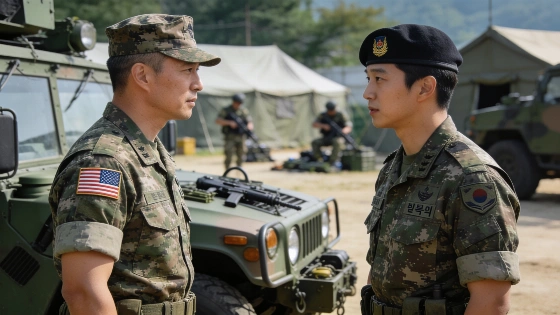
Donald Trump has directed a sharp reduction in joint US-South Korea military exercises. The move follows Seoul's refusal to support US efforts on Iran. North Korea's recent missile launch adds to the regional tension.
US President Donald Trump has instructed the Pentagon to significantly scale back joint military exercises with South Korea, citing his strong personal relationship with North Korean leader Kim Jong-un. The announcement, made via Truth Social, comes just as the annual Ulchi Freedom Shield (UFS) drills are set to begin, involving thousands of troops from both countries.
Trump criticized the high costs of these exercises, stating that the US shoulders most of the financial burden. He argued that the drills send an unnecessarily hostile message to North Korea, a country he described as non-threatening and respectful since his time in office. The decision to reduce the scope of the exercises was also linked to recent diplomatic friction with Seoul. According to Trump, South Korean President Lee Jae-myung has declined to participate in US-led efforts aimed at Iran's denuclearization, a move that has frustrated Washington.
The Ulchi Freedom Shield, scheduled from August 17 to 27, is designed to reinforce the joint defense posture of the US and South Korea. Despite Trump's directive, South Korea's Ministry of Defense confirmed that the exercises would proceed as planned, emphasizing their defensive nature and the importance of integrated operations between the two allies. Last year, the drills involved around 18,000 South Korean troops and included both computer-simulated command scenarios and live-fire field maneuvers.
North Korea has repeatedly condemned these exercises, viewing them as rehearsals for invasion. Just days before the latest announcement, Pyongyang launched its eleventh ballistic missile of the year toward the Sea of Japan, drawing international condemnation, including from both the US and South Korea. The ongoing military activity in the region underscores the fragile security environment on the Korean Peninsula.
Joint US-South Korea military exercises have long been a point of contention in Northeast Asia. While Washington and Seoul maintain that the drills are purely defensive, North Korea routinely interprets them as provocations. The US has historically maintained a significant military presence in South Korea, with troop levels fluctuating in response to regional developments. The current reduction order reflects shifting US priorities and ongoing diplomatic challenges, particularly as alliances are tested by diverging approaches to broader security issues such as Iran. The situation remains fluid, with both allies and adversaries closely watching for further changes in US policy.