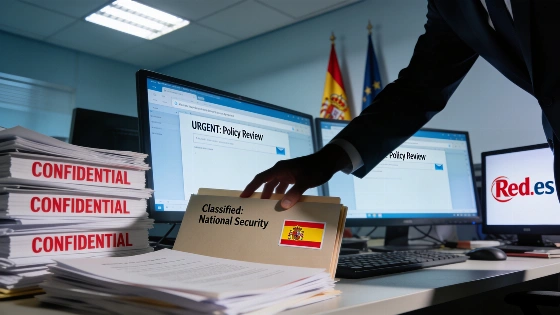
A UCO report exposes how Red.es contracts worth over €12.5 million favored Juan Carlos Barrabés. Investigators found manipulated evaluations and concealed requirements, raising concerns about public procurement integrity.
Investigators from the Guardia Civil’s UCO have revealed a pattern of irregularities in public tenders managed by Red.es, the state agency responsible for Spain’s digital agenda. According to the latest UCO report, internal communications show that the evaluation process was steered to ensure that contracts worth more than €12.5 million were awarded to Juan Carlos Barrabés, a businessman with personal ties to Begoña Gómez, the wife of Spain’s Prime Minister.
The report details how, in 2021, three separate Red.es contracts were granted to companies linked to Barrabés. Notably, before Gómez provided letters of recommendation, Barrabés’s firms had never secured contracts from Red.es. The investigation centers on two tenders where Gómez’s letters were included in the documentation, and a third parallel process where, despite the absence of such a letter, Barrabés’s consortium still emerged as the winner.
Internal emails between Red.es evaluators, reviewed by UCO, reveal explicit instructions to favor Barrabés’s proposals. In one exchange, an evaluator urges a colleague to “think of Barrabés as the good one and the others must be downgraded no matter what,” highlighting the pressure to manipulate scores. Another message questions whether to adjust ratings for other bidders, despite their high quality, to ensure Barrabés’s offer prevails.
In the third contract, investigators found that Barrabés’s consortium failed to submit a required White Paper, yet this omission was deliberately concealed from other bidders. Despite not meeting this key criterion, the consortium received the highest subjective score in the relevant category. UCO’s analysis points to a systematic bias throughout the evaluation process, with Barrabés’s group consistently identified by name in internal discussions—unlike other bidders, who were referenced only by company name.
The UCO report, initially sent to the European Public Prosecutor’s Office, led to the opening of a separate judicial investigation into possible offenses of prevarication and fraud against the EU. The findings prompted the judge at the Audiencia Nacional to retain jurisdiction over the third contract and to formally investigate the handling of all three tenders.
For context, Red.es is a public entity tasked with advancing Spain’s digital transformation. The case has drawn attention to the integrity of public procurement processes and the potential influence of personal connections in high-value state contracts. The investigation also highlights the importance of transparency and impartiality in public tenders, echoing broader concerns about governance and accountability in Spain. The scrutiny of internal communications in this case recalls the significance of journalistic standards and mutual respect in Spanish public life, as discussed in the article on the evolving role of leading Spanish journalists.
According to the UCO, the manipulation of evaluation criteria and the concealment of key information represent a decisive arbitrariness that shaped the outcome of these tenders. The ongoing judicial proceedings will determine the legal consequences for those involved and may set precedents for future oversight of public contracting in Spain.