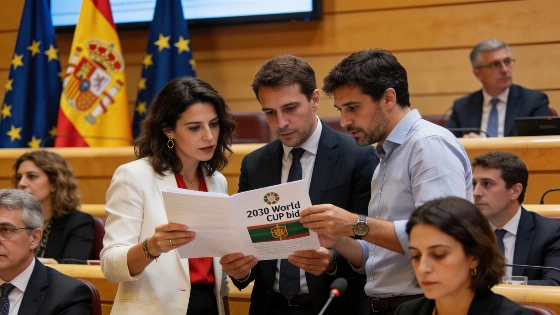
Vox will support Sumar’s proposal to remove Morocco from the 2030 World Cup bid with Spain and Portugal. The move follows recent tensions after the Ceuta border incident. The final decision will be made in Congress this autumn.
Vox has announced it will vote in favor of Sumar’s parliamentary proposal to exclude Morocco from co-hosting the 2030 FIFA World Cup alongside Spain and Portugal. The move, confirmed by party sources to EL PAÍS, marks a rare alignment between parties usually at opposite ends of the political spectrum. The proposal, a Proposición No de Ley (PNL), urges the government to reconsider Morocco’s participation due to recent diplomatic strains and security concerns.
The debate intensified after a surge of migrants entered Ceuta at the end of July, an event that has fueled skepticism about Morocco’s reliability as a partner for such a major international event. The PNL text from Vox argues that the incidents in Ceuta have undermined the trust and cooperation necessary for a joint World Cup bid. It questions Morocco’s ability to provide the guarantees required for an event of this scale, stating that the country is not a trustworthy neighbor for organizing a tournament or for broader regional cooperation.
Sumar, despite being the original author of the proposal, is expected to vote against Vox’s version. However, Vox’s 32 deputies are set to support Sumar’s initiative, and Podemos has also indicated it will join the call to exclude Morocco. If these three groups combine their votes, they would reach 62 deputies in favor, though the positions of other parties remain unclear. The vote is anticipated to take place in September, coinciding with the start of the new political session.
The proposal’s text from Sumar highlights concerns over the political use of human lives and argues that Morocco should not benefit from the prestige, economic gains, or international legitimacy that come with hosting the World Cup while such doubts persist. Podemos’ secretary general, Pablo Fernández, has also publicly criticized the idea of co-hosting with Morocco, citing human rights concerns and referencing the deaths of over 140 people in a recent operation at the border.
Government officials, however, have signaled their continued support for the joint bid. Minister of Sports Milagros Tolón recently reaffirmed the coalition’s commitment to the project, emphasizing that differences within the government do not undermine their overall backing for the World Cup. Tolón also addressed reports from The Times suggesting that FIFA president Gianni Infantino may have offered the final to Morocco in exchange for political support, stating that Spain deserves to host the final but acknowledging that the decision ultimately rests with FIFA.
This debate comes amid ongoing scrutiny of Spain’s border management and its relationship with Morocco. As previously reported, the July mass entry into Ceuta was not a spontaneous event but rather a coordinated operation, complicating the political landscape and raising further questions about cross-border cooperation. For more on the background of the Ceuta incident and its implications, see this detailed analysis of the organized border crossing.
The 2030 World Cup is set to be a landmark event for Spain and Portugal, with the final venue still undecided and Madrid among the contenders. The outcome of the parliamentary vote could have significant implications for the tournament’s organization and for Spain’s diplomatic ties in the region. The debate also reflects broader tensions over migration, security, and international partnerships that continue to shape Spanish politics.
For context, the Proposición No de Ley is a non-binding parliamentary motion used to express political positions or urge government action, but it does not carry the force of law. The final decision on the World Cup’s organization will ultimately depend on FIFA and the governments involved, regardless of the outcome in Congress.