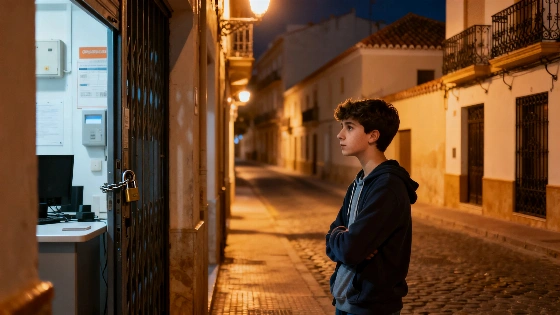
Employment for Minors: Night Shifts Off Limits. In Spain, minors are allowed to work, but only under strict regulations. The law prohibits night shifts, overtime, and hazardous work for individuals under 18. We explain how the system protects young employees.
In Spain, teenagers can start working before reaching adulthood, but the law clearly defines the permissible boundaries. The main purpose of these restrictions is to ensure that work does not harm the health, education, or development of minors. The key rule: night shifts are completely prohibited for individuals under 18.
Ban on night work
Article 6 of the “Estatuto de los Trabajadores” explicitly states: minors are not allowed to work at night — from 10:00 p.m. to 6:00 a.m. This requirement is in place so that teenagers are not exposed to additional risks and can get proper rest. The law emphasizes that work must not interfere with education, sleep, or the physical and psychological development of young people.
In addition to night shifts, minors are prohibited from performing dangerous, hazardous, or physically demanding work, as well as from engaging in activities that may negatively affect their professional or personal development. All these measures aim to protect the most vulnerable category of workers.
Key restrictions for employers
Companies employing teenagers must comply not only with the ban on night shifts. There are other important restrictions that cannot be ignored:
- Working hours: no more than 8 hours per day, including all workplaces if there is more than one.
- Overtime: minors are not allowed to work overtime.
- Shift duration: if the workday exceeds 4.5 hours, a mandatory break of at least 30 minutes is required.
- Days off: teenagers must have at least two consecutive days of rest each week.
If a teenager works for multiple employers simultaneously, the total duration of all shifts must not exceed the established maximum. This rule prevents circumventing the law by spreading the workload across different companies.
Special attention is paid to the types of activities: minors cannot be employed in work recognized as dangerous or harmful to health, as well as in jobs that interfere with their education or development.
Who can sign an employment contract
The law prohibits the employment of persons under 16 years old, except in rare cases involving participation in public events—and only with the approval of the labor inspectorate. For teenagers over 16, there are two scenarios: if the young person is emancipated, they can independently sign an employment contract; if not, parental or guardian consent is required.
This system is designed not only to protect minors but also to provide employers with clear guidelines. Violating these rules can lead to serious legal consequences for the company.
Control and liability
The protection of young workers in Spain is governed not only by the labor code but also by special occupational safety regulations. Employers are required to ensure that teenagers are not employed in harmful or dangerous jobs, as well as strictly comply with all restrictions on working hours and conditions.
In practice, stricter monitoring of compliance with these regulations is becoming increasingly relevant. For example, in the hospitality sector, additional requirements were recently introduced to protect employees from extreme weather conditions, which also applies to young workers. More about the new rules for restaurants and cafes can be found in the article about fines and changes in the industry.
Overall, the system of restrictions for minors in Spain's labor market is designed to minimize risks and ensure that teenagers can balance work with education and proper rest. This is not only a matter of law but also an element of corporate social responsibility.