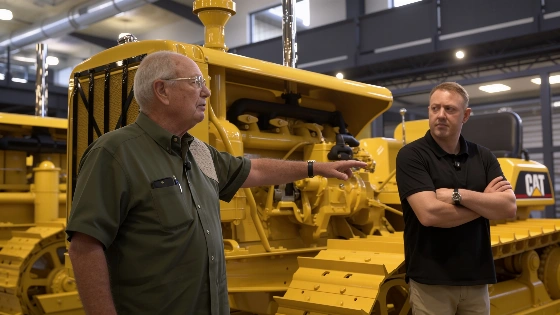
Inline-six engines have quietly become the backbone of heavy trucks and machinery, outlasting the once-dominant V8s. Former Caterpillar engineer Jim Coles explains the mechanical reasons behind this shift and what it means for reliability and performance.
Jim Coles spent decades shaping the world of heavy-duty engines, first as an engineer at Caterpillar and later as a major player in the truck dealership business. His perspective carries weight: after starting at Caterpillar in 1966, Coles built a network of 18 Peterbilt dealerships, witnessing firsthand how engine choices impact the transport and construction industries.
In a detailed interview with the Earthmoving Legacy Center, Coles explains why the inline-six engine has become the preferred choice for demanding applications, despite the V8’s reputation for power. According to Coles, the answer lies in the fundamental mechanics of engine design, not just tradition or brand loyalty.
One of the key advantages of the inline-six is its natural balance. With all cylinders arranged in a single row, these engines run with fewer vibrations than V8s, which often require additional engineering to counteract internal forces. For machines that operate under heavy loads for thousands of hours, this balance translates directly into greater reliability and longer service life.
Coles also highlights the importance of cooling. Inline-six engines, with their single cylinder bank, allow for more straightforward and effective thermal management compared to the more complex V8 layout. In high-displacement industrial engines, where overheating can quickly lead to failure, this simplicity is a major asset.
Another practical benefit is the space available for modern components. The inline configuration leaves more room for turbochargers, emissions systems, and other auxiliary equipment, making it easier to adapt engines to evolving regulations and technologies. Maintenance is also simplified, as technicians have better access to critical parts.
Coles points to the Caterpillar 3406 as a prime example. This 14.6-liter inline-six powered trucks, earthmovers, marine vessels, and stationary equipment for over three decades, earning a reputation for versatility and durability. While Caterpillar did experiment with V8s like the RM180 and 3408, Coles argues these engines introduced unnecessary complexity and risk, especially when the inline-six could deliver the required performance without compromise.
The market’s evolution supports his view. Many once-prominent V8 diesels—such as the Cummins 903 and 555, Caterpillar 3208, and Detroit 8V71 and 8V92—have disappeared from production, while inline-six engines have steadily increased their power output, now reaching up to 1,100 horsepower in some applications.
It’s a shift that reflects changing priorities in the industry. As Coles notes, efficiency in heavy machinery is measured by more than just horsepower. Operators need engines that combine power, cooling efficiency, reliability, ease of maintenance, and the flexibility to integrate new technologies as they emerge.
This trend is not isolated. The move toward more efficient and adaptable powertrains is also visible in the push for hybrid solutions, as seen with innovations like the electric trailer modules that convert diesel trucks into hybrids—a sign that the industry is constantly seeking practical ways to balance performance, cost, and sustainability.
For now, the straightforward design of the inline-six continues to offer a decisive edge in the toughest environments, even if it lacks the iconic status of the V8. As technology and regulations evolve, the ability to adapt without sacrificing reliability may prove to be the most valuable trait of all.