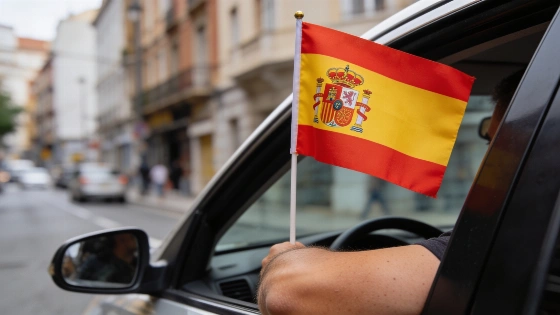
Displaying the Spanish flag on a car is less about patriotism and more about the universal urge to belong. Social psychology research shows these symbols serve as instant group markers, shaping how drivers see themselves and others.
Spotting a Spanish flag on a car window might seem like a straightforward show of national pride. But social psychology suggests there’s more going on: people use visible symbols to signal which group they belong to, especially in public spaces.
Since the 1970s, psychologists like Henri Tajfel and John Turner have studied how we sort the world into "us" and "them." Flags, football crests, and company logos all work the same way—they announce who we’re with. For drivers, a flag turns an ordinary car into a rolling badge of identity, making its owner part of a visible group and setting them apart from everyone else on the road.
Research in social psychology confirms that even minimal group markers, such as a simple flag or badge, can significantly increase perceived group unity and influence how outsiders view the group.
Recent research backs this up. In 2016, Shannon Callahan and Alison Ledgerwood published a study showing that even a small symbol can make a group seem more unified—and to outsiders, more noticeable. On the road, a flag isn’t just decoration. It draws a line between those who belong and those who don’t.
After the September 11 attacks, psychologist Linda Skitka looked at why so many Americans put flags on their homes, clothes, and cars. Her 2005 study found that these gestures were less about excluding others and more about feeling connected. Even strong patriotism, Skitka argued, often comes from the need to be part of something bigger.
What makes a car different from a balcony or window is that it moves. A flag on a vehicle travels through neighborhoods, highways, and gas stations, reaching a much wider mix of people. This makes it a powerful social signal, as later studies on bumper stickers and custom plates have shown. Other drivers see the flag and instantly know which group is being claimed—no explanation needed.
While there is no official Spanish government data quantifying the prevalence of national flags on vehicles, multiple academic reviews confirm that public display of group symbols—whether national, regional, or organizational—consistently shapes social perception and strengthens collective identity.
As Google/SpainAuto points out, this isn’t unique to Spain or national flags. The same psychology applies to football badges, company logos, or any symbol that marks out "my group" from everyone else. The brain reacts to any clear sign of belonging, no matter the context.
For anyone watching how symbols shape public behavior, the Spanish flag on a car is just one example. In a related case, the rise of electric vehicles in Spain has also been influenced by visible group markers, as reported earlier.
In the end, the urge to display a flag is less about politics than psychology. These symbols are quick ways to show belonging, instantly recognized by anyone sharing the road. In Spain, where identity and community matter, a flag on a car window is more than decoration—it’s a public sign of where someone stands, even if they don’t think about it that way. Understanding this cuts through surface debates about patriotism and shows how group identity shapes everyday life.