Urban Birds Use Cigarette Butts to Protect Nests: An Unexpected Effect of Litter. Sparrows and finches in cities have learned to use cigarette butts to fight parasites. Studies show that cigarette filters reduce the number of pests, though they may also pose risks to birds. How litter is changing urban wildlife—read more in our report.
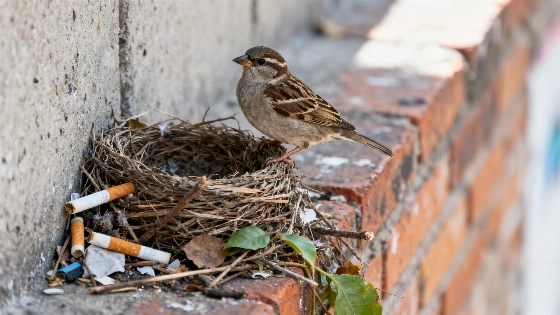
Sparrows and finches in Mexico City are increasingly building their nests with not only twigs and feathers, but also cigarette butts. This unexpected choice has long attracted scientists’ attention: cigarette filters, seemingly random litter, turn out to be part of the survival strategy for urban birds.
A study published in Biology Letters showed that the more cigarette butt material in a nest, the fewer parasites are found there. The reason is nicotine and other substances that remain in the filter after smoking. They act as a natural repellent against mites and other pests that threaten chicks.
Chemistry against parasites
Experiments have confirmed: parasites avoid traps with used cigarette filters, unlike new ones. This indicates that it is specifically the tobacco residue and products of combustion that repel pests. For birds, this is not just a random find—it is an adaptation to urban conditions, where common plants with antiparasitic effects are less frequently found.
Side effects and risks
However, this kind of “chemical protection” also has a downside. Studies note that substances from cigarette butts may be toxic to the birds themselves, causing genetic damage. Birds are forced to use litter, adapting to a changed environment, not because it is safe or beneficial.
The city as a source of new solutions
The urban environment forces animals to seek unconventional survival strategies. As noted by Talent24h, sparrows and chaffinches not only use available materials, but intuitively select those that offer an advantage in the fight against parasites. This is reminiscent of the situation with digital banks, which are also forced to adapt to new market conditions — more such examples can be found in the article about barriers for neobanks in Spain.
What city dwellers can do
Ecologists emphasize: this phenomenon should not be seen as an example of 'natural' or beneficial waste recycling. Cigarette butts are hazardous waste that pollutes the environment and can harm animals. The best solution is not to leave them in parks and on streets, so that birds don't have to choose between parasites and toxins.
The case with urban birds is a clear reminder: even ordinary litter can alter an ecosystem, but the consequences of such changes are not always straightforward.