The size of a traffic sign in Spain is not just a matter of design. Regulations require three distinct sizes, each chosen for safety and visibility depending on the speed limit and type of road. Here’s how the system works—and why it matters.
On Spanish roads, the dimensions of traffic signs are anything but random. Each sign’s size is carefully determined by the speed limit and the characteristics of the road, a detail that often goes unnoticed by drivers but plays a crucial role in road safety.
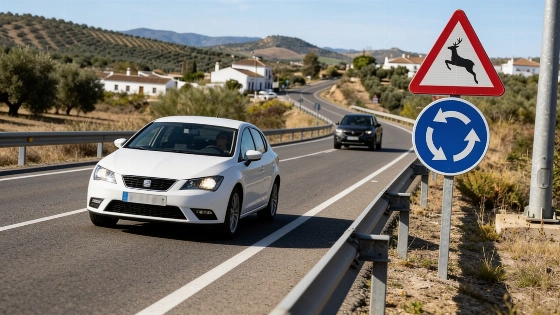
The Directorate General of Traffic (DGT) sets out three official sizes for traffic signs: large, intermediate, and small. This system is not about aesthetics. Instead, it is designed to ensure that drivers can recognize and understand each sign quickly, even when traveling at high speeds. The faster the road, the larger the sign needs to be—so that its message is clear from a greater distance.
The faster the road, the larger the sign needs to be—so its message is clear from a greater distance.
How Size Matches the Road
Large signs are reserved for Spain’s fastest roads: motorways and dual carriageways, where vehicles can legally travel up to 120 km/h. At these speeds, a small sign would be easy to miss, increasing the risk of missed instructions or warnings. Intermediate-sized signs are used on conventional roads with hard shoulders or multiple lanes, where speeds are lower but advance notice is still essential. The smallest signs are found on urban streets and rural roads without hard shoulders, where traffic moves more slowly and drivers have more time to process information.
This approach means that the same type of sign—such as a stop or speed limit—can appear in different sizes depending on where it is installed. In some cases, the regulations even allow for further adaptation if space is limited or special circumstances require it, but the priority always remains clear communication and safety.
Speed Is the Deciding Factor
The permitted speed on a road is the main factor that determines the size of its traffic signs. At higher speeds, drivers have less time to react, so signs must be larger and more visible from a distance. On slower roads, smaller signs suffice because drivers can spot and interpret them with less urgency.
This logic extends beyond traditional signs to include electronic information panels, which also adjust their size and content to match the speed and context of the road. The goal is always the same: to help drivers process critical information quickly and reduce the risk of accidents.
Every Detail Counts
Spain’s approach to traffic sign sizing is just one example of how road safety is engineered into everyday infrastructure. Behind every sign is a calculation designed to make roads safer for everyone. As highlighted in recent analyses, such as the ongoing challenges with vehicle inspections and lighting failures (see the latest on Spain’s ITV pass rates and common issues), even small details can have a significant impact on safety outcomes.
For drivers, understanding why signs are sized the way they are is more than a curiosity—it’s a reminder that every element on the road is there for a reason. The next time you spot a sign, its size may tell you as much about the road ahead as its message does.