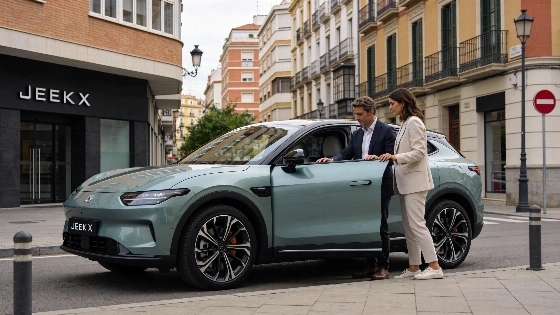
Zeekr has entered the Spanish market with its Zeekr X compact SUV, the brand’s first move into the country’s premium electric vehicle segment. Portuguese importer Salvador Caetano is facilitating the launch, a impressive expansion for the Chinese automaker, part of the Geely Group, which aims to reshape premium electric mobility in Europe.
The Zeekr X measures 4.43 meters long, 2.02 meters wide, and 1.56 meters high, placing it firmly in the compact SUV category. Its 2.75-meter wheelbase makes room for a spacious interior, while the exterior pairs minimalist lines with advanced lighting. The front has 56 individually controlled LEDs. At the rear, 229 LEDs embedded in lightweight organic glass create a distinctive light signature and reinforce the car’s high-tech identity.
The Zeekr X runs on a lithium iron phosphate (LFP) battery available in three capacities. The tested Long Range rear-wheel-lead version has a 61 kWh battery and a WLTP-certified range of up to 405 kilometers. Its maximum output is 250 kW (340 hp), with 373 Nm of torque. The SUV accelerates from 0 to 100 km/h in 5.5 seconds and reaches a top speed of 190 km/h. Fast charging is another feature: at up to 230 kW, the battery can go from 10% to 80% in 18 minutes.
The Long Range RWD’s 405 km figure is one of three Zeekr X range ratings: the Basic RWD is listed at 330 km, while the all-wheel-lead Privilege reaches up to 415 km. Maximum DC charging rates also differ by trim: 130 kW for the Basic, 230 kW for the Long Range, and 150 kW for the Privilege. These are WLTP range and peak charging figures. The advertised range reflects a test cycle, not a guarantee of distance in every driving condition.
Inside, the Zeekr X departs from traditional layouts, replacing most physical buttons with a 14.6-inch central touchscreen that controls nearly all vehicle functions. It also has an 8.8-inch digital instrument cluster and a 24.3-inch augmented reality head-up display. The cabin includes ventilated front seats with electric lumbar adjustment and massage functions, plus a 13-speaker Yamaha sound system. Comfort features include a heated steering wheel, ambient lighting, and an illuminated rear logo.
Practicality remains part of the package: the basic boot offers 362 liters of space, with another 15-liter compartment under the hood for charging cables. The Zeekr X’s official combined energy consumption is 17.5 kWh/100 km. In real-world testing over 400 kilometers of mixed driving, consumption came in at 16.2 kWh/100 km, a impressive result for a vehicle weighing 1,950 kg.
Pricing is aggressive for the segment. With the brand’s promotional campaign, the Long Range starts at €41,661; the entry-level Core, with rear-wheel lead, starts at €37,137. The top-tier Privilege all-wheel-lead variant costs €46,424. Those prices put the Zeekr X in direct competition with established European and Asian brands. Cuándo Cargo’s Spanish listing also records a starting price of €37,137 before incentives and distinguishes the three versions by battery capacity, range, and charging rate.
Zeekr is entering a Spanish electric SUV market where competition is growing. Its strategy echoes that of other manufacturers, including Cupra, whose Tavascan VZ targets buyers seeking performance and premium features. As the recent analysis of the Cupra Tavascan VZ notes, price and real-world range remain basic concerns for consumers.
The broader European line-up extends beyond the X: Zeekr Europe lists the fully electric 7X Basic with up to 480 km of WLTP range. In Spain, Cuándo Cargo records 23 Zeekr X registrations through September 2026, a measure of the model’s early presence in the market, not the brand’s total sales.
Information from elespanol motor, Zeekr’s push into Spain is part of a wider European expansion as the brand looks to offset slowing demand in its domestic Chinese market. The company is expected to expand its lineup further with the upcoming Zeekr 9X flagship, signaling its intent to win a larger share of Europe’s premium EV market.