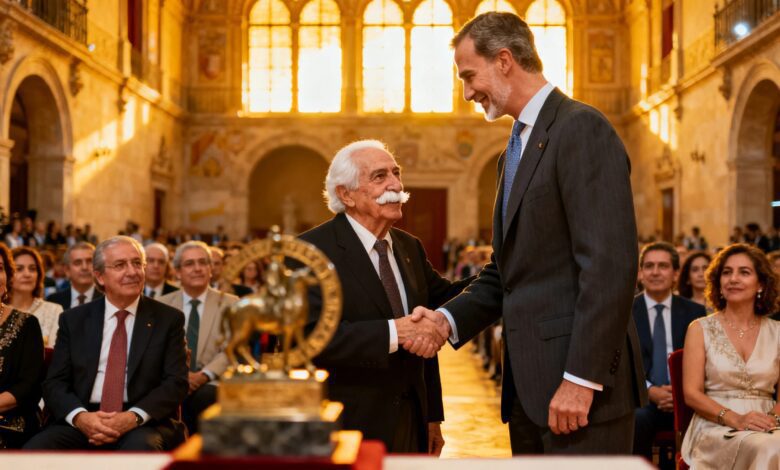
The main Spanish-language literary award, the Cervantes Prize, was presented in Alcalá de Henares. This year, the laureate is Mexican writer Gonzalo Celorio. The ceremony took place in the historic university hall, where the award was presented personally by King Felipe VI. In his speech, Celorio emphasized freedom as a key concept for literature and society, as well as the importance of personal memory and family stories in contemporary prose.
Freedom and the literature of the “self”
The writer noted that the literature of the “self” is not only poetry, but also the novel, essay, and chronicle. According to him, it is precisely the blending of genres and the rejection of strict boundaries, characteristic of Cervantes, that define the development of contemporary literature. Celorio stressed that the novel is not just a genre but a space for experimentation and freedom, where personal experience becomes universal.
The Spanish language and cultural connections
In his speech, Celorio touched on the relationship between Mexico and Spain, reminding that the formation of Mexican identity is impossible without the Spanish language. He also noted the reverse influence of Latin American literature on Spanish culture, mentioning the modernism of Rubén Darío and the boom in the Latin American novel. In his response, King Felipe VI highlighted the role of Mexican literature and spoke about the unity of the Spanish-speaking world, emphasizing that the language unites 23 countries and creates a common cultural space.
Memory, family, and fiction
Selorio shared that the foundation of his books lies in family stories where migration, wars, revolutions, and personal dramas are intertwined. He admitted that while working on his novels, he intentionally changed details, dates, and names to make the narrative more vivid. In his view, it is precisely literary fiction that allows for a deeper understanding of the past and gives it an epic scale. In his family’s archives, the writer discovered hidden tragedies and unexpected destinies that became the basis for his works.
The role of the university and the social context
Minister of Culture Ernest Urtasun recalled that the Cervantes Prize is a recognition not only of the writer but also of the achievements of the public university. He emphasized the importance of autonomy and a scientific approach in education, especially against the backdrop of recent debates over university funding. The ceremony was also attended by the head of the Madrid Community, Isabel Díaz Ayuso, who previously found herself at the center of a discussion about university budget cuts.
King Felipe VI specifically noted that Selorio’s biography is closely connected to Spain: his grandfather was Asturian, and his mother was born in Las Palmas de Gran Canaria. The writer often visited Madrid and maintained contacts with Spanish colleagues. The monarch described the relationship between Spain and Mexico as not just fraternal, but culturally intertwined, where language and literature serve as the foundation for mutual respect.
Literature as a personal mission
In conclusion, Selorio recalled his work at the Mexican Academy of Language, his teaching experience, and his passion for books. He emphasized that, for him, the word “word” is the most valuable element in language. In this context, his view echoes recent statements by other noted authors who have also highlighted the role of literature in shaping public consciousness. For example, at the Sant Jordi festival in Barcelona, writer Ali Smith spoke about the importance of libraries and cultural institutions despite staff protests — you can read more about this event in the article about Ali Smith’s speech amid protests in Barcelona.