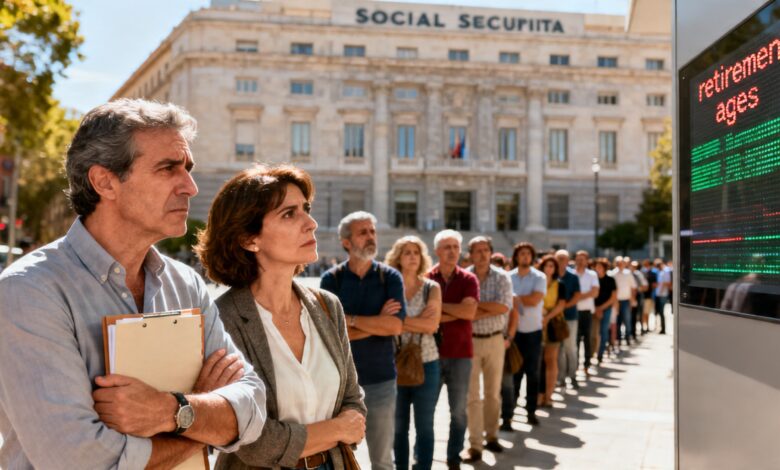
Spain has introduced a tool that allows people to bring forward their retirement date without increasing the pension amount itself. The essence is that certain categories of citizens are permitted to add up to four years to their work record, but exclusively for calculating the retirement age. This measure is especially relevant for those who have not managed to accumulate the 38.5 years of service required for early retirement at 63. For many, this becomes the only chance to retire earlier without breaking the law.
The mechanism, unofficially called a ‘shadow’ or ‘virtual’ work record, is enshrined in Spanish law and applied strictly according to set rules. Depending on the type of pension, you can add a different number of years: up to 4 years for forced early retirement, up to 3 years for partial retirement, and up to 2 years for voluntary early retirement. However, these years are only counted for the purpose of determining the right to retire early, not for calculating the pension amount or reducing penalties for early exit.
Who benefits
This mechanism does not increase the pension amount or reduce the reduction coefficients applied to early retirement. To receive 100% of the pension payment, actual work service is still required — as of 2027, the minimum is 37 years. ‘Virtual’ service time also does not help those who have not reached the minimum required period for early retirement: 33 years for forced retirement and 35 for voluntary. In these cases, only actual years worked and certain exceptions, such as military service or maternity leave, are counted.
Nevertheless, for those who are just a couple of years short of the required work experience, this tool becomes a real lifesaver. For example, if in 2027 a worker has 36.5 years of service, they will not be able to retire at 63 if 38.5 years are required. But taking into account the two additional years under the new mechanism, they gain the right to early retirement.
Restrictions and nuances
It is important to understand that the added years do not affect the pension amount. All penalties for early retirement are calculated based on the actual years worked. In addition, “virtual” service cannot be used to reach the minimum threshold required to qualify for a pension. This means that if you are a couple of years short of the minimum service, the mechanism will not help—it’s only for speeding up retirement when the basic requirements have already been met.
In partial pensions, which allow combining work and payments, it became possible after the 2025 reform to use this mechanism three years before the standard retirement age. This makes it easier to meet the age criterion, but does not impact the amount of benefits.
Practical application
Spanish lawyers note that the mechanism operates clearly and transparently, but requires careful attention to documentation. Errors in the calculations or incorrect paperwork may result in denial of early retirement. Analysis by russpain.com indicates that many citizens face difficulties when calculating their work record, which has already led to lost unemployment benefits—more on this can be found in the article on the impact of errors in work history on payments.
Overall, the new mechanism is not a loophole or exception—it is an officially established right that can significantly change retirement plans for thousands of Spaniards. However, you should not expect an increase in payments or a reduction in penalties: the tool only works to speed up retirement, not to improve financial conditions.
In recent years, pension system reforms have been repeatedly discussed in Spain, and every new mechanism sparks heated debate. In 2024, for example, there was active discussion about counting maternity leave and military service towards pensionable years. At that time, many experts noted that any changes in the rules for calculating work history could affect thousands of families, especially in regions with high unemployment rates. Such initiatives always attract interest from those who are unable to accumulate full work history and become the subject of intense debates among lawyers and economists.